


Modern manufacturing floors are constantly generating data through a vast array of sensors, PLCs, and automated systems. Despite this, teams are blindsided by sudden outages, slow cycle times, or quality drifts.
The truth is, most of that data generated by sensors never reaches the teams that need it. Where every second of downtime and every percentage of yield matters, this lack of visibility can have devastating consequences.
What’s in this article:
- Why manufacturing floors lack visibility into operations despite being equipped with modern technology
- How a connected factory can be implemented using Manufacturing Connect and GCP
- How our architecture supports real-time performance, OEE, and energy metrics
Data That Never Leaves the Factory Floor
For many manufacturers, the concept of Smart Factory is an elusive goal. This is despite the staggering amount of information generated at the machine level. There are three major barriers to access:
- Varying machine languages: Each vendor uses different protocols, registers, and data formats. Connecting these disparate systems requires specialized knowledge.
- Data is messy and lacks context: Raw PLC signals don’t explain what product is running, whether output is within specification, or why a machine stopped.
- Cloud integration is not straightforward: Security, latency, and volume management complicate direct data transfer from the shop floor.
For one of our manufacturing clients, this became a major pain point. To address this, we developed a solution that would provide them with a real-time view of machine performance as well as executive-level reports.
A Clear Path from Machines to Cloud Intelligence: Manufacturing Connect + Google Cloud
Below is the high-level architecture combining Manufacturing Connect (MC) and Google Cloud’s Manufacturing Data Engine, which enables a seamless flow of data from the factory floor to the cloud, which is eventually visualized in Grafana.

Now let’s see what happens on the factory floor in detail below:
Data such as temperature, cycle count, etc., from industrial devices is processed and stored locally at the edge device. It is then sent to GCP via Pub/Sub through Manufacturing Connect (MC).

Once that data is received by MC, a Dataflow pipeline processes it and gets it ready for consumption.
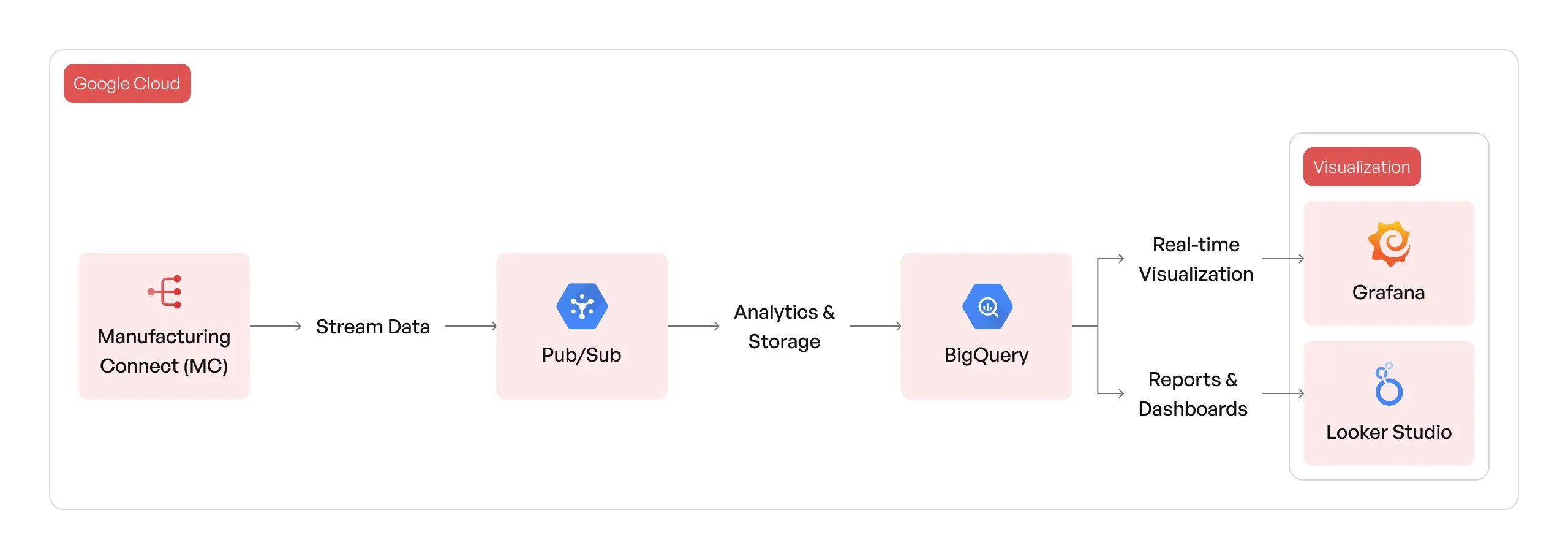
The following are the key components of this architecture:
1. Data Acquisition at the Edge
On the factory floor, Manufacturing Connect Edge (MCe) connects directly to devices, PLCs, drives, and sensors using industrial protocols like MQTT, OPC UA, and Modbus. It offers out-of-the-box support for a wide range of industrial protocols and native drivers for industrial devices like Siemens, Delta PLC, ABB, etc (See the complete list here). It structures the raw data, applies basic processing, and handles local buffering so that no data is lost even if the network goes down.
2. Manufacturing Connect in the Cloud for Edge Device Management
Manufacturing Connect (MC) is deployed as an application in the Google Kubernetes Engine (GKE) Cluster on Google Cloud Platform (GCP). It acts as a centralized platform for edge device management for all the MCe instances. It offers secure mass deployment, over-the-air updates, and automated actions, giving control over edge devices and data.
3. Google Cloud Pub/Sub for Ingestion
The data stored in MCe is sent securely to Google Cloud, where it arrives in Pub/Sub, Google’s scalable messaging backbone. From there, a data pipeline transforms, enriches, and contextualizes the data, giving it meaning. For example, raw temperature or cycle-time readings become business-useful time series, mapped to the machines, lines, and shift metadata. Custom Dataflow pipelines in GCP enable configurable control over storage formats and target data sinks, such as BigQuery for analytics or time-series databases for operational monitoring.
4. BigQuery for Storage and Analysis
Once structured, the data lands in BigQuery, Google Cloud’s analytics data warehouse. Here, teams can run SQL queries, combine machine telemetry with operational data (like orders or maintenance logs), and shape the data into analysis-ready datasets and models for use cases such as root cause analysis of downtime, improving Overall Equipment Effectiveness (OEE), reducing quality defects, and optimizing energy usage and production efficiency.
5. Visualization with Looker Studio and Grafana
To transform raw data into actionable insights, we utilized Grafana dashboards and Looker Studio. The Grafana dashboards offer a real-time view of factory machines, such as their running state (active, idle down), cycle times, and uptime. With Looker Studio, users can generate reports on energy consumption to identify cost-saving opportunities, OEE trends, quality issues, etc. While we opted for these two tools, the underlying data layer can be integrated seamlessly with any industry-standard visualization tool based on organizational preference.
Turning Raw Data into Operational Intelligence
The above architecture empowers teams to:
- Detect performance drops as they occur, as anomalies are detected in real time.
- Identify the root causes of downtime by correlating machine events, sensor data, and operator actions.
- Ensure all machines are operating optimally and improve overall throughput.
- Monitor quality metrics in real time using sensor data to detect deviations early, reducing rework and overall production losses.
- Predict failures before they disrupt production.
With these capabilities, the client can easily access data for answering critical operational questions such as:
- What’s causing recurring downtime?
- Can we optimize cycle times and reduce energy costs?
- How do we predict failures before they halt production?
Instead of reacting to issues after the fact, teams can now operate with a clear, real-time understanding of what is happening on the shop floor and why.
Designed for Scalability and Security
When dealing with industrial data, reliability and security matter just as much as insights.
Here’s how our architecture supports enterprise-scale deployments:
- Easy integration with 290+ industrial protocols and devices.
- Secure communication between edge devices and cloud using TLS encryption, with certificate-based authentication and managed device credentials to establish trust.
- Redundant buffering at the edge to prevent data loss.
- Access control and Identity Access Management (IAM) for data governance.
- Auto-scaling ingestion pipelines for growing production lines.
- Separation of IT and OT networks with controlled interfaces.
- Role-based dashboards for engineering, operations, and management.
Closing the Loop for Smart Manufacturing
As we've seen, the main challenge in shifting from a reactive to a proactive, data-driven operation isn't the lack of data, but the fragmentation of that data across incompatible languages and isolated systems. By bridging the gap between these fragmented machine languages and the analytical power of Google Cloud, our architecture removes the technical barriers that typically keep factory data stranded at the edge.