Assembly-Line Inspired AI Grading Engine for Medical Student Evaluations
Overcoming operational propagation delays in clinical grading through a multi-stage linear validation architecture and automated AI summarization workflows.
Client
A premier United States-based academic medical center and leading healthcare education provider, consistently ranked among the top 10 hospitals nationwide by U.S. News & World Report.
Problem Statement
The client’s legacy medical student evaluation system was plagued by systemic propagation delays, cross-system data silos, and heavy manual entry requirements that slowed down the release of crucial clinical rotation reports.
Industry
Quick Summary
We engineered a modular, step-by-step evaluation pipeline inspired by the structured efficiency of an industrial assembly line.
- Integrated an AI-powered automated scoring and document generation engine that aggregates student parameters from disconnected core networks.
- Achieved a 30% increase in overall evaluation processing speed while eliminating manual data entry bottlenecks across clinical blocks.
Client Profile
This leading integrated academic health system coordinates medical education, advanced clinical research, and extensive patient care operations across multiple regions. Supported by a workforce of over 40,000 healthcare professionals, educators, and researchers, the organization relies on enterprise-grade software automation to maintain rigorous academic standards for its highly competitive medical school cohorts.
Challenges: Propagation Delays and Segmented Data Blocks
Grading medical students during clinical rotations introduces highly complex, multi-tiered data challenges:
- Systemic Propagation Delays: Evaluation metrics from localized clinics experienced severe transmission lags before reaching central academic files, causing deep administrative queues.
- Heavy Manual Intervention: Administrative coordinators spent significant time manually extracting examination outputs, validation scores, and preceptor feedback from separate networks.
- Absence of Modern Analytics: The lack of native automation and AI integration forced faculty to manually synthesize massive amounts of performance text when drafting final residency recommendation letters.
- Inconsistent Quality Controls: Relying on human collation across distributed rotation sites introduced risks of calculation errors and variance in evaluation timelines.
QBurst Solution: AI-Powered Automated Evaluation Pipeline
We engineered an innovative, step-by-step evaluation platform custom-built for the rigorous workflow needs of medical schools. Modeled directly after the streamlined engineering of an industrial assembly line, the platform passes data records sequentially through an isolated, automated processing stack.
The digital transformation unifies the grading lifecycle into highly specialized functional tracks:
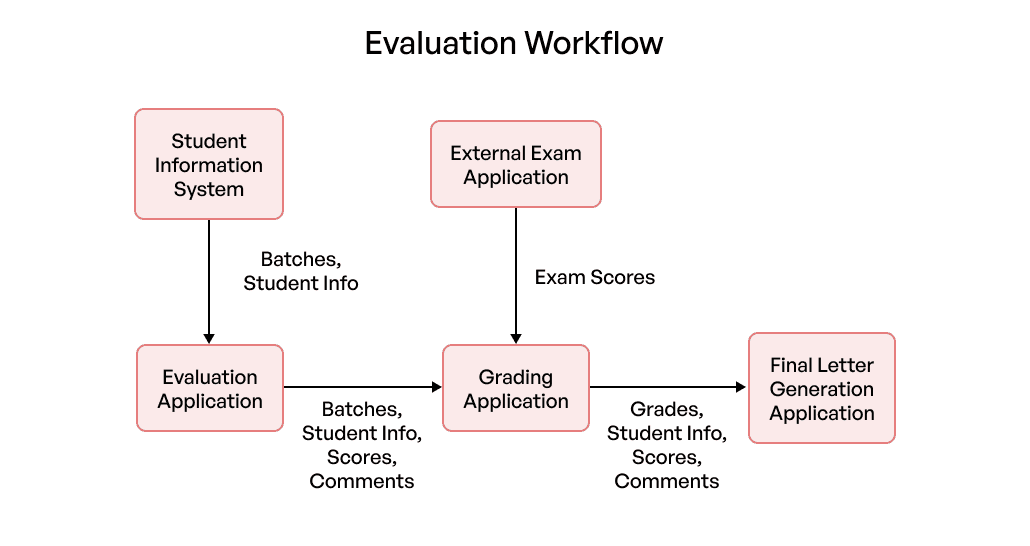
- Automated Data Ingestion & Sync: Replaces manual record collation by connecting directly to institutional databases, pulling student rosters and clinical rotation parameters instantly without data lag.
- Linear Stage-Gate Processing: Pipes each evaluation payload through an isolated series of calculation modules, ensuring that every file undergoes identical quality controls and metric enrichments before moving to the next stage.
- Multi-System Score Integration: Automatically aggregates quantitative examination marks from external testing networks, merging them with qualitative preceptor field notes to calculate an objective raw score.
- AI-Driven Grading Classification: Leverages rules-driven automation to determine final letter grades based on the calculated total score, matching strict institutional curves and historical performance baselines.
- Generative AI Report Orchestration: Utilizes advanced Natural Language Processing (NLP) components to synthesize tabular scoring data and written feedback into professional, print-ready student summaries and residency recommendation letters.
Key Features and Technical Highlights
- Isolated Multi-Stage Architecture: Decoupled functional microservices prevent resource contention and isolate processing tasks to protect data pipeline uptime.
- Synchronized SIS Interop Data Connectors: Automated API bridges fetch database records on demand, erasing data siloing across campus networks.
- Automated Aggregation Matrix: Custom calculation engines execute multi-system data merges, instantly uniting objective exam marks with subjective field notes.
- Generative Text Summarization: Refined Large Language Models transform tabular scoring arrays and bulleted preceptor feedback into professional, print-ready student narratives.
- Rigid Institutional Quality Guardrails: Transparent scoring rules ensure the automated AI classification layer operates strictly within defined grading boundaries.

Impact
- 30% Acceleration in Evaluation Speed: Automated pipelines eliminated administrative data lag, ensuring medical students receive final rotation marks weeks faster than legacy limits.
- Minimized Back-Office Workload: Replacing manual data collation with an assembly-line framework frees up coordinators to focus on direct student support.
- Flawless Evaluation Uniformity: Standardizing data pathways ensures every student file goes through identical quality controls, eliminating human step-omission errors.
- Turnkey Performance Reports: Integrated AI text generators produce highly detailed summaries instantly, giving residency committees comprehensive performance visibility on demand.
Client Profile
Challenges
QBurst Solution
Technical Highlights
Impact