Logo & Wordmark
Industries
Solutions
Services
Innovation & Insights
Company
Industries
Solutions
Services
Innovation & Insights
Company

Recognized for Growth. Trusted for Impact.

Tell us what you need help with.

Deloitte Technology Fast 50 India, Winner 2024

Deloitte Fast 50 India, Winner 2024

peak_matrix

Major Contender, QE Specialist Services

IDC-Logo-BeaconBlue 1

Market Glance: Loyalty in Retail, 2Q26, DEOT 4Q25

HFS Logo

Horizon 1 Disruptor, Data Modernization & AI Services, 2026


Logo & Wordmark
ISO
QBurst on LinkedIn
QBurst on YouTube
QBurst on X
QBurst on Facebook
QBurst on Instagram
IndustriesRetailRealtyHigh-TechHealthcareManufacturing
SolutionsDigital ExperienceIntelligent EnterpriseProduct EngineeringManaged AgentsModernization
ServicesExperience DesignDigital EngineeringDigital PlatformsData Engineering & AnalyticsApplied AICloudQuality EngineeringGlobal Capability CentersDigital Marketing
Innovation & InsightsBlogCase StudiesWhitepapersBrochures
CompanyLeadershipClientsPartnersCorporate ResponsibilityNews & MediaCareersOur LocationsGrowth Referral
  • Industries
  • Solutions
  • Services
  • Innovation & Insights
  • Company

© QBurst 2026. All Rights Reserved.

Privacy Policy

Cookies & Management

Certifications

  1. Innovation & Insights
  2. Resources
  3. Case Studies

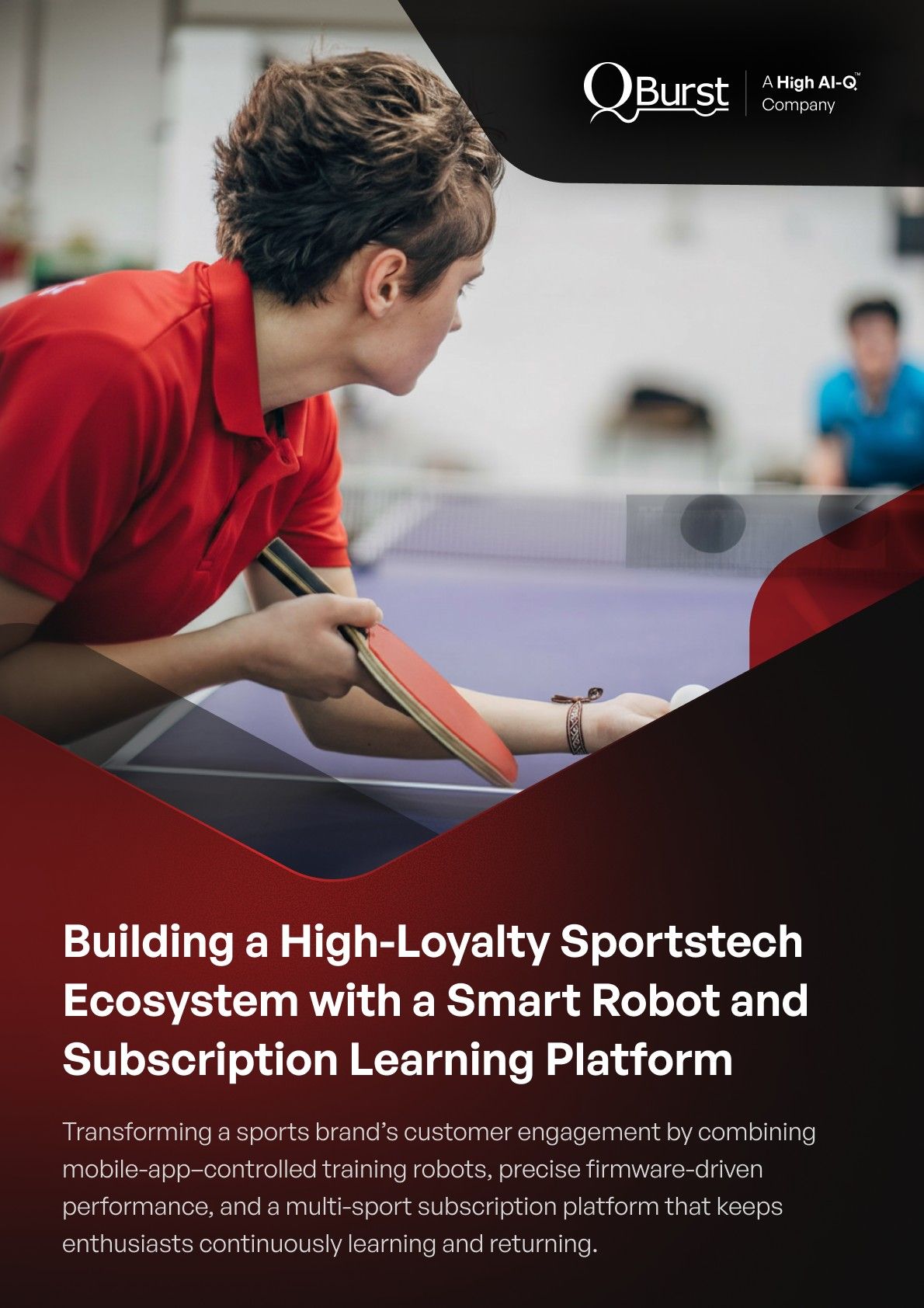
Building a High-Loyalty Sportstech Ecosystem with a Smart Robot and Subscription Learning Platform

Transforming a sports brand’s customer engagement by combining mobile-app–controlled training robots, precise firmware-driven performance, and a multi-sport subscription platform that keeps enthusiasts continuously learning and returning.

Client

German multinational corporation that creates a wide range of sports equipment and accessories.

Problem Statement

The client wanted to transform a standalone training robot into a connected sports ecosystem with consistent performance, personalized control, and ongoing digital engagement.

Industry

High-Tech

Solution

Digital Experience

Product Engineering

Intelligent Enterprise

building-a-high-loyalty-sportstech-ecosystem-with-a-smart-robot-and-subscription-learning-platform
Download PDF

Quick Summary

  • Delivered firmware evolution and software intelligence for a mobile-controlled smart training robot enabled by precise shot stability, and calibration-aware motor behavior.
  • Engineered an autonomous calibration system using computer vision, a master robot reference, and onsite mobile-assisted calibration.
  • Developed a multi-sport subscription learning platform featuring HLS video, personalized recommendations, live coaching, multilingual subtitles, and in-app payments.
  • Built a role-based admin CMS for coaches and content teams to publish structured lessons and tutorials.
  • Established a unified hardware + digital ecosystem that improves engagement and drives recurring subscription revenue.
  • Shot variability reduced by >75%, factory calibration time reduced by 50%, and significantly improved customer loyalty through personalized drills and a recurring subscription content ecosystem.

Client Profile

The client is a German multinational corporation that creates a wide range of sports equipment and accessories for players, both professional and recreational. As a regular sponsor at the Olympic Games and multiple international competitions, clubs, and athletes, our client is one of the most visible sports equipment manufacturing brands in the world.

Challenges: Performance Instability and Scalability Limits

  • The robot used an open-loop motor system, causing speed drift, inconsistent spin, and unpredictable ball placement, with no sensors to self-correct variations caused by heat, voltage, or motor wear.
  • Post-manufacturing variability in power adapters, motor drivers, and motors themselves resulted in inconsistent units.
  • No unified firmware architecture existed to manage PID control, telemetry, calibration ingestion, and task prioritization, causing timing collisions and stability issues.
  • Firmware lacked a reliable way to ingest calibration data from the vision system, and minimal logging made field troubleshooting difficult.
  • Accurate calibration required sub-centimetre landing measurement, precise camera-shot synchronization, and a way to convert video data into adjustments for X/Y placement, launch angle, and wheel speed.
  • The digital platform needed scalable delivery of multi-sport content with HLS streaming, subscriptions (Stripe/Apple/Google), entitlements, personalization, and role-based content operations.

A Connected Sports Ecosystem Built on Digital Experience

Companion Mobile App for Controlling the Robot

  • Smartphone-based interface for complete robot control.
  • Users can select drills, fine-tune speed, spin, angle, and shot placement, and save custom presets.
  • BLE protocol enables real-time communication with the robot.
  • Calibration mode lets users mark the ball's landing position using a calibration sheet overlay within the app.
  • The mobile app serves as the central command center for robot operation and user engagement.

Autonomous Calibration System

  • Calibration addresses performance variations caused by differences in motors, drivers, and power adapters.
  • A master robot executes predefined shot sequences, with reference values captured for X/Y landing position, launch angle, and motor speed.
  • Computer vision uses an iPhone camera positioned at 90° to the table and a table tennis calibration grid to accurately map landing positions.
  • The CV pipeline compares actual landing points with reference values to measure deviations.
  • An XYZ adjustment model is generated to compensate for X/Y placement, motor speed, and launch angle.
  • Firmware applies these calibration deltas to ensure every robot performs consistently with the master unit.

Firmware Transformation

  • Closed-loop PID motor control continuously monitors and adjusts motor speed for consistent shot delivery.
  • Real-time corrections compensate for wear, heat, and voltage variations, with future support for RPM sensor integration.
  • Deterministic real-time task scheduling prioritizes:
    • High-frequency ISR-driven tasks for motor PID loops and feeder-wheel speed control.
    • Mid-priority tasks for sensor sampling, calibration logic, and motor health monitoring.
    • Lower-priority tasks for BLE communication, diagnostics, and UI commands.
    • A safety watchdog to prevent timing conflicts and ensure stable operation.
  • Firmware directly consumes JSON calibration profiles generated during computer vision calibration.
  • Automatic adjustment of X, Y, launch angle, and motor speed ensures consistent performance across all units.
  • Each shot records RPM, temperature, motor load, timing, calibration deltas, errors, and safety events for troubleshooting, predictive maintenance, and reliability.
  • Modular OTA-ready architecture enables secure firmware updates, new drills, tuning improvements, and feature enhancements after deployment.

Multi-Sport Subscription Learning Platform

  • HLS-based video lessons with adaptive playback.
  • Personalized recommendations and guided learning paths.
  • Multi-language subtitles, chapter navigation, and podcast mode.
  • Subscription management through Stripe, Apple, and Google.
  • Live coaching sessions using YouTube Live.
  • Notifications for new drills, firmware updates, and learning content.

Admin & Coach Tools

  • Role-based administration for coaches, editors, and content managers.
  • Visual Tutorial Editor for creating multi-step lessons with videos, instructions, and annotations.
  • Content review and publishing workflows.
  • Analytics dashboard for tracking user engagement and content performance.

Technical Highlights

  • Real-time firmware control built in C/C++ on an RTOS, with deterministic control loops and precisely tuned PID for consistent motor RPM and shot stability.
  • Robust motion and sensor stack using incremental encoders for RPM feedback, and SPI/I²C sensors for current, thermal, and system health monitoring.
  • Edge compute on STM32H7/G4 MCUs, optimized for motor control, low-latency task execution, and safety-critical watchdog supervision.
  • Computer-vision calibration pipeline using Python, OpenCV, and PyTorch/TensorFlow to track ball trajectories, estimate landing points, and generate per-unit calibration profiles.
  • Calibration delta processing implemented in C++/Python with fast lookup tables enabling the firmware to instantly apply corrections during shot execution.
  • Synchronized factory capture using high-speed global-shutter cameras and automation scripts to ensure frame-accurate shot analysis.
  • Safety-first design including hardware watchdogs, thermal and current sensors, overload protection, and software safety interrupts.
  • Scalable admin UI built with React, Vite/Turbopack, and Tailwind, delivered via micro-frontend architecture (single-spa/module federation) for modular content management and coaching workflows.
  • Backend telemetry and analytics powered by PostgreSQL + TimescaleDB/InfluxDB for time-series data, Kafka/MQTT for robot telemetry, and Prometheus/Grafana + ELK/OpenSearch for monitoring and diagnostics.

Impact

  • >75% reduction in shot variability with closed-loop firmware.
  • Stable, predictable motor performance regardless of environment or component differences.
  • 70% reduction in calibration time due to automated CV workflows.
  • Robots ship with near-master accuracy, reducing returns.
  • Faster field diagnosis with telemetry logs.
  • Subscription platform drives recurring revenue, higher retention, and increased app engagement through customizable drills.
  • Multi-sport expansion creates a scalable training ecosystem.
  • Product becomes a firmware-led competitive differentiator.
  • Foundation built for future devices, sports, and unified content experiences.

Client Profile

Challenges

QBurst Solution

Technical Highlights

Impact