Logo & Wordmark
Industries
Solutions
Services
Innovation & Insights
Company
Industries
Solutions
Services
Innovation & Insights
Company

Recognized for Growth. Trusted for Impact.

Logo (1)

Deloitte Fast 50 India, Winner 2024

Clip path group

Major Contender, QE Specialist Services

IDC-Logo-BeaconBlue 1

Market Glance: Loyalty in Retail, 2Q26, DEOT 4Q25

HFS Logo

Horizon 1 Disruptor, Data Modernization & AI Services, 2026


Logo & Wordmark
ISO
QBurst on LinkedIn
QBurst on YouTube
QBurst on X
QBurst on Facebook
QBurst on Instagram
IndustriesRetailRealtyHigh-TechHealthcareManufacturing
SolutionsDigital ExperienceIntelligent EnterpriseProduct EngineeringManaged AgentsModernization
ServicesExperience DesignDigital EngineeringDigital PlatformsData Engineering & AnalyticsApplied AICloudQuality EngineeringGlobal Capability CentersDigital Marketing
Innovation & InsightsBlogCase StudiesWhitepapersBrochures
CompanyLeadershipClientsPartnersCorporate ResponsibilityNews & MediaCareersOur LocationsGrowth Referral
  • Industries
  • Solutions
  • Services
  • Innovation & Insights
  • Company

© QBurst 2026. All Rights Reserved.

Privacy Policy

DEI Policy

Cookies & Management

Certifications

  1. Innovation & Insights
  2. Resources
  3. Case Studies

Extending Microsoft CoE Starter Kit into an Operational Governance Framework

Transforming tenant-wide Power Platform inventory into an automated, actionable operational governance engine across six enterprise pillars.

Client

A premier UK facilities and infrastructure management service provider.

Problem Statement

Rapid Power Platform adoption created visibility without operational context, leading to untracked data risks, orphan apps, unmonitored flow failures, and manual governance overhead.

Industry

High-Tech

Education & Professional Services

Solution

Intelligent Enterprise

Modernization

Cover page extending-microsoft-co-e-starter-kit-into-an-operational-governance-framework
Download PDF

Quick Summary

QBurst extended the Microsoft Power Platform CoE Starter Kit for the client, creating a custom intelligence and operational governance layer around the baseline administrative data model.
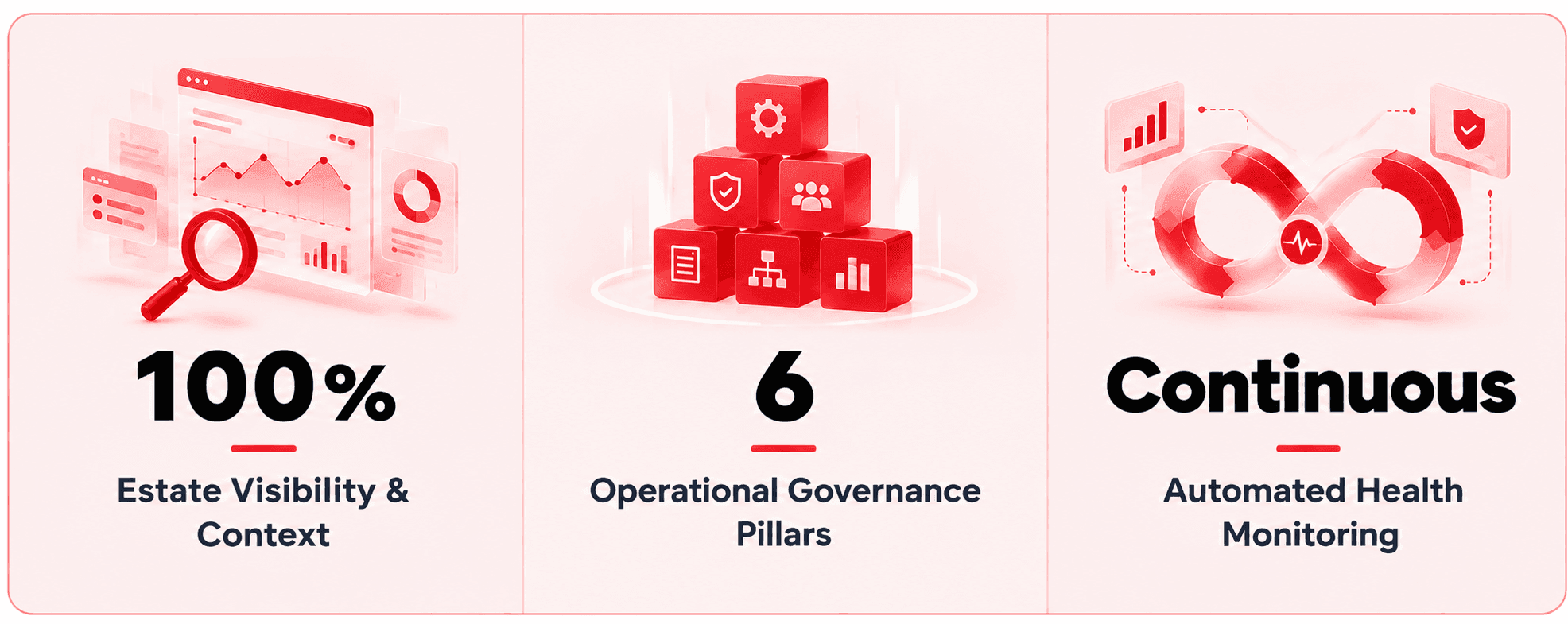
  • Operationalizing Platform Telemetry: Converted static CoE inventory into actionable workflows across six pillars—Identity Security, DLP & Connectors, ALM, Operations Monitoring, Environment Strategy, and Licensing.
  • Measurable Governance Impact: Replaced periodic reporting with real-time decision records, automated risk scoring, proactive health monitoring, and lifecycle controls without restricting safe, business-led low-code development.
quick summary.png

Client Profile

A UK-based facilities services firm that specializes in tasks requiring precise operational tracking. The enterprise relies heavily on digital applications and automated workflows to coordinate field operations, client servicing, and organizational workflows nationwide. 

Inventory Without Operational Action

While the default CoE Starter Kit provided visibility into apps, flows, and environments, platform administrators lacked the business context needed to manage risk and service continuity effectively.

  • Inventory Without Business Context: Connector lists and maker records lacked critical metadata regarding data sensitivity, business purpose, and support tiering.
  • Complex DLP and Integration Risks: Assessing HTTP and custom connectors required manual review, leaving potential data exposure risks unmanaged.
  • Fragmented Environment Management: Lacked automated provisioning, environment tiers, and centralized environment policy enforcement.
  • Reactive Operational Support: Flow failures went unnoticed or reached incorrect owners, while staff changes created orphan apps and service interruptions.
  • Inconsistent ALM & Release Controls: Lack of standardized solution boundaries, release evidence, and pipeline automation increased deployment risks.

Operational Governance Extension Layer

We built an enterprise governance extension on top of the CoE Starter Kit, converting platform telemetry into assigned, time-bound operational workflows.

  • Business Context & Enriched Metadata: Added risk scoring, support tiering, business criticality fields, and mandatory ownership reviews to all discovered Power Platform assets.
  • Automated Request & Approval Workflows: Implemented structured approval paths for environment provisioning, custom connector usage, DLP exceptions, and premium license allocations.
  • Proactive Health & Incident Routing: Deployed health monitoring rules that detect failed flows, evaluate incident severity, and route tickets directly to responsible application owners.
  • Lifecycle & Orphan Mitigation: Created automated workflows to detect inactive assets, manage maker transitions, enforce application-user patterns, and execute safe archival/retirement policies.
  • Governance Control Center & Reporting: Built a centralized Governance Control Center app alongside operational Power BI dashboards to track health, risk tiers, capacity, and compliance metrics.

Technical Highlights

  • CoE Dataverse Extension Schema: Extended the standard Microsoft CoE administrative data model with custom decision tables, risk metrics, and audit logs.
  • Granular Six-Pillar Control Scope: Operationalized governance across Identity Security, DLP/Connectors, ALM, Monitoring, Environment Strategy, and Licensing/Capacity.
  • Custom API & Metadata Processing: Engineered C#/Azure API processing services to extract high-volume metadata, run automated rule checks, and sync system states.
  • Automated ALM Pipelines: Enforced solution-based delivery, environment stage gating, pipeline evidence collection, and automated rollbacks across environments.
  • Smart Model & Policy Selection: Implemented dynamic policy mapping and Managed Environments integration to scale administrative controls elastically.

Scalable Operating Model for Low-Code Growth

  • Operational Decision Loop: Transitioned platform governance from a periodic audit exercise into an automated, day-to-day operational cycle (Discover, Enrich, Assess, Decide, Act, Monitor, Review).
  • Mitigated Data & Operational Risk: Established strict guardrails for HTTP/custom connectors, credential management, and PII exposure across all environments.
  • Improved Service Continuity: Reduced downtime by 30% for business-critical flows through automated failure alerts, incident routing, and ownership continuity tracking.
  • Scalable Low-Code Adoption: Empowered business makers to build within predefined safety boundaries while ensuring enterprise IT retains complete visibility and control.

Client Profile

Challenges

Solution

Technical Highlights

Impact