Logo & Wordmark
Industries
Solutions
Services
Innovation & Insights
Company
Industries
Solutions
Services
Innovation & Insights
Company

Recognized for Growth. Trusted for Impact.

Logo (1)

Deloitte Fast 50 India, Winner 2024

Clip path group

Major Contender, QE Specialist Services

IDC-Logo-BeaconBlue 1

Market Glance: Loyalty in Retail, 2Q26, DEOT 4Q25

HFS Logo

Horizon 1 Disruptor, Data Modernization & AI Services, 2026


Logo & Wordmark
ISO
QBurst on LinkedIn
QBurst on YouTube
QBurst on X
QBurst on Facebook
QBurst on Instagram
IndustriesRetailRealtyHigh-TechHealthcareManufacturing
SolutionsDigital ExperienceIntelligent EnterpriseProduct EngineeringManaged AgentsModernization
ServicesExperience DesignDigital EngineeringDigital PlatformsData Engineering & AnalyticsApplied AICloudQuality EngineeringGlobal Capability CentersDigital Marketing
Innovation & InsightsBlogCase StudiesWhitepapersBrochures
CompanyLeadershipClientsPartnersCorporate ResponsibilityNews & MediaCareersOur LocationsGrowth Referral
  • Industries
  • Solutions
  • Services
  • Innovation & Insights
  • Company

© QBurst 2026. All Rights Reserved.

Privacy Policy

DEI Policy

Cookies & Management

Certifications

  1. Innovation & Insights
  2. Resources
  3. Case Studies

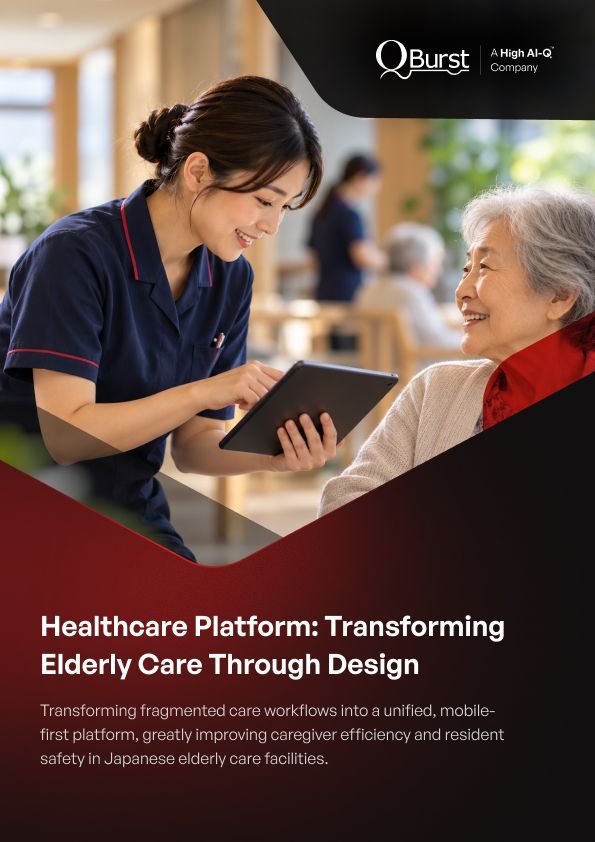
Healthcare Platform: Transforming Elderly Care Through Design

Transforming fragmented care workflows into a unified, mobile-first platform, greatly improving caregiver efficiency and resident safety in Japanese elderly care facilities.

Client

A healthcare platform provider aimed at revolutionizing elderly care monitoring for care facilities in Japan.

Problem Statement

User research revealed that 78% of caregivers experienced alert fatigue due to the existing monitoring system. Shadowing and interviews with 15 caregivers (ages 35–50) uncovered critical disruptions: alert handling required an average of 45 seconds per notification, 12% of critical alerts were missed during peak hours, and cognitive overload caused a 34% increase in response time.

Industry

Healthcare

Solution

Digital Experience

Modernization

Product Engineering

healthcare-platform-transforming-elderly-care-through-design
Download PDF

Quick Summary

QBurst redesigned a fragmented elderly care monitoring ecosystem for the client, shifting the platform from zero UX maturity to a human-centered, role-based digital experience.

  • Unified Multi-Role Ecosystem: Delivered a mobile suite for caregivers, a web dashboard for facility managers, and an admin portal for facility oversight—all backed by a scalable, accessible design system.
  • Workflow Optimization & Safety: Integrated smart alert clustering, color-coded priority cues, and bulk alert actions to streamline critical care routines.
  • Measurable Clinical & Business Growth: Achieved a 67% reduction in alert response time, reduced critical misses to 1.8%, and drove a 200% increase in new facility acquisitions.

    15s (from 45s)1.8% (From 12%)8.7/10(From 3.2)
    Alert Response TimeCritical Alert MissesUser Satisfaction Score

Client Profile

A Japan-based HealthTech company specializing in digital solutions for elderly care. They design proprietary sensors and an integrated platform to monitor seniors’ health and routines, enhancing care quality and operational efficiency for caregivers.

Design Challenges: Fragmented Interfaces and Alert Fatigue

User research and contextual discovery uncovered severe usability friction that directly threatened resident safety and staff well-being.

  • High Alert Fatigue: 78% of caregivers suffered from alert fatigue due to continuous, unprioritized notifications.
  • System Fragmentation: Caregivers were forced to manage 4 to 6 different interfaces daily without a single source of truth.
  • Severe Mobile Gaps: 89% of caregivers needed mobile access to check alerts while moving between rooms, but the existing platform lacked dedicated mobile workflows.
  • Workflow & Communication Blind Spots: Lack of integrated communication or activity logs hampered care continuity across shifts.
  • Zero Initial UX Maturity: The client initially requested a simple alert dashboard redesign, which addressed only 20% of actual user pain points.

User-Centric Approach & UX Strategy

We conducted deep immersion in real user environments to expand the product vision from a basic dashboard into a unified healthcare ecosystem.

  • Contextual Discovery & Shadowing: Conducted site shadowing and interviews with 15 caregivers (ages 35–50) and usability testing sessions with 25 caregivers across 5 care facilities.
  • Ecosystem Mapping: Mapped interconnected touchpoints across care receivers, caregivers, facility managers, and administrators to uncover hidden workflow bottlenecks.
  • Rapid Iterative Usability Cycles: Facilitated 3 rapid feedback and testing iterations, driving overall task success rates from a baseline of 61% up to 94%.
  • Incremental UX Maturity Building: Established trust through early website and interface wins, demonstrating design value through data-driven metrics.

User Journey & Design Highlights

The design focused on a cohesive, multi-touchpoint experience tailored to the operational contexts of distinct care roles:

  • Role-Based Touchpoints
    • Mobile Suite for Caregivers: Real-time monitoring and one-touch alert response optimized for caregivers moving between care receiver rooms.
    • Web Dashboard for Managers: Facility-wide oversight with integrated staff allocation tools.
    • Admin Portal: Multi-facility management and inventory tracking.
  • Scalable Accessible Design System: Built a component library from basic icons to complex data visualizations, enabling 70% faster feature development and ensuring WCAG 2.1 AA compliance.
  • Smart Alert Interaction Design
    • Color-Coded Alert Priorities: Reduced visual recognition time by 82%.
    • Grouped Notifications: Grouping related alerts cut interaction time by 40% in testing; room-proximity clustering was then added to address remaining friction.
    • Predictive & Bulk Actions: Implemented one-click bulk actions and learning-based filters to reduce cognitive overload.

Impact: Clinical Efficiency and Commercial Transformation

The human-centered design transformation yielded major improvements in clinical operations, user satisfaction, and business growth.

  •  Clinical & Operational Gains
    • Alert Response Time: Decreased from 45 seconds to 15 seconds (67% improvement).
    • Critical Alert Misses: Dropped from 12% to 1.8% during peak hours.
    • Daily Efficiency: Saved 4.5 hours per facility per day across daily tasks.
    • User Satisfaction: Satisfaction score increased from 3.2 to 8.7 out of 10.
  • Business & Market Growth
    • Client Retention: Improved by 45%.
    • Facility Acquisition: Increased new facility acquisitions by 200%.
    • Platform Reusability: Templatized the platform into a white-label version for a premium client in 3 weeks (down from an original 4-month build).
  • Ecosystem Portfolio Expansion
    • Internal Tools: Automated office workflows, saving 12 hours weekly per employee.
    • Learning Platform: Created an integrated training platform that reduced caregiver onboarding time by 50%.

Client Profile

Challenges

QBurst Solution

Technical Highlights

Impact