Transforming industrial energy monitoring with hybrid AI models, contextual intelligence, and real-time anomaly detection.
A Sweden-based energy technology startup delivering SaaS solutions for industrial energy optimization and sustainability.
Detecting operationally meaningful energy anomalies across industrial equipment with highly dynamic consumption behavior.
The client is a Sweden-based smart energy management startup focused on helping industrial enterprises optimize energy consumption and meet sustainability objectives. Its SaaS platform delivers actionable operational insights, anomaly detection, forecasting, and reporting capabilities that enable manufacturers to monitor, reduce, and predict energy usage across complex industrial environments.
Industrial equipment such as ovens, furnaces, cutting machines, surface treatment systems, foaming units, and shaping machines exhibited highly variable energy consumption patterns across production cycles. Distinguishing meaningful anomalies from expected operational fluctuations, seasonal behavior, and recurring usage patterns was critical to ensuring reliable interventions and reducing unnecessary alerts.
The client required a highly adaptive and scalable solution capable of:
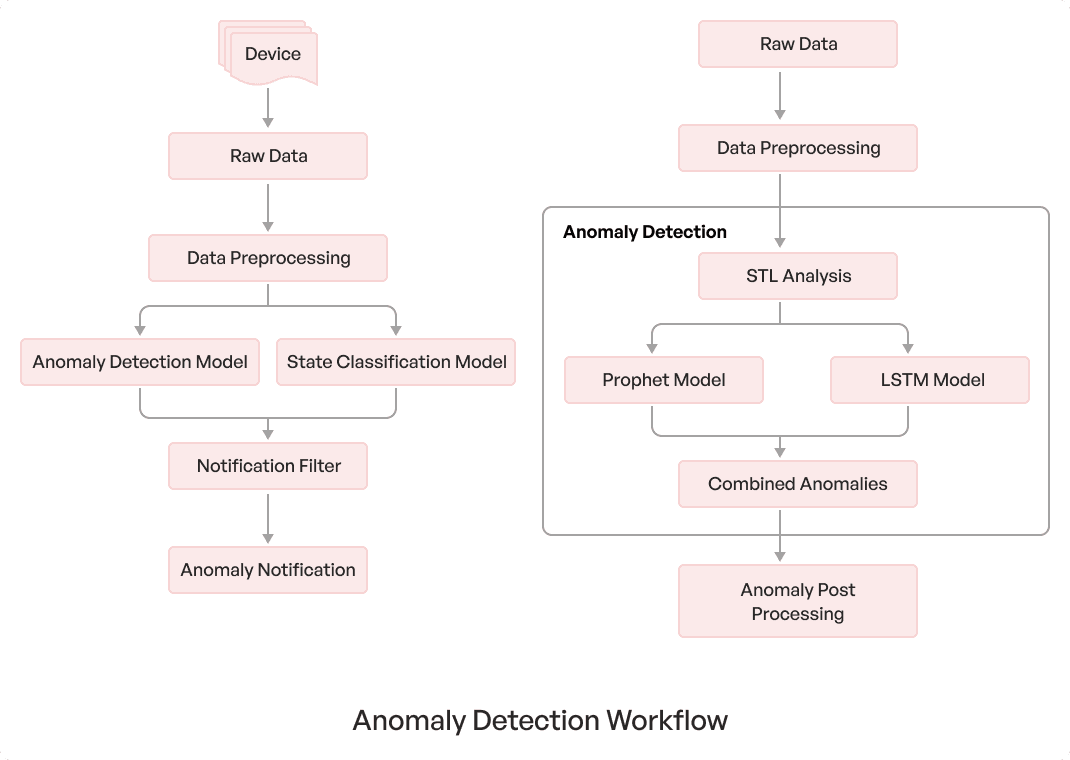
We developed a cloud-native anomaly detection framework that combined advanced time-series analysis, probabilistic state classification, and business-aware filtering to identify operationally relevant anomalies across industrial manufacturing environments.
Our approach began with exploratory data analysis and statistical modeling to understand historical energy consumption patterns across devices. We analyzed power demand variations over time, identified different operational states, and observed recurring spikes, drops, and seasonal behaviors associated with production schedules and time-of-day dependencies.
Initial statistical approaches successfully identified basic outliers but lacked the ability to account for historical trends and sequential dependencies. We then evaluated clustering-based machine learning techniques, which proved effective for isolated anomalies but insufficient for contextual time-series analysis. These findings highlighted the need for models capable of learning both temporal relationships and seasonal trends.
To address this, we implemented a hybrid anomaly detection architecture using STL decomposition with both Prophet and LSTM models.
The solution continuously refined model accuracy through feedback-driven tuning and adaptive learning mechanisms.
We implemented a scalable real-time ingestion framework integrating diverse industrial sensors monitoring:
Edge devices, including Raspberry Pi systems, facilitated local sensor data collection and communication with gateways. MQTT was used as the lightweight messaging protocol for efficient and reliable cloud transmission, ensuring high data integrity with minimal to zero data loss.
To improve anomaly contextualization, we developed a dedicated device state classification module capable of identifying operational states such as Off, Sleep, Standby, and Production. Traditional hard clustering methods proved ineffective because several industrial devices exhibited overlapping power ranges across different operational states. To address this complexity:
This contextual awareness significantly improved the relevance and reliability of alerts delivered to end users.
We designed a rule-based filtering layer in close collaboration with the client to ensure only business-critical anomalies generated notifications. This approach substantially reduced alert fatigue while improving user trust and operational usability. Configurable filtering logic incorporated:
All anomalies, classifications, and contextual explanations were visualized through dynamic dashboards with full traceability support, including:
The frontend platform, built using React and HighCharts, enabled intuitive real-time and historical monitoring experiences. Integration with AWS API Gateway also supported third-party visualization and seamless Power BI exports for advanced analytics and reporting.
The platform was designed as a modular, containerized microservices architecture capable of horizontal scaling across multiple factories and device classes. This modular design enabled independent scaling and updating of system components without impacting overall platform stability. Independent services handled:
The solution leveraged a robust AWS ecosystem including EC2, AWS MQ, RDS, S3, Lambda, API Gateway, SQS, ECR, Kinesis Data Streams, EventBridge, SageMaker, Systems Manager, Auto Scaling Groups, and Application Load Balancers to support reliability, scalability, and operational efficiency.
The system successfully identified a wide range of operationally significant anomalies, including:
Client Profile
Challenges
QBurst Solution
Technical Highlights
Impact