Automating Healthcare Provider Biographies with Generative AI
Accelerating patient-facing clinician profile deployment through an event-driven serverless workflow and automated natural language drafting.
Client
A premier, top-ranked United States-based academic medical center and health system.
Problem Statement
The client’s manual, fragmented processes for creating provider biographies led to highly inconsistent quality, outdated patient-facing directories, and severe operational publication delays.
Industry
Solution
Quick Summary
We engineered a centralized Generative AI platform to automate the end-to-end lifecycle of clinician profiles from initial intake to final public distribution.
- Achieved a 55% faster turnaround time across the health system, shrinking bio completion cycles from nine business days down to four.
- Reduced profile drafting effort for busy clinicians by 60%, dropping initial data-input time frames to just 12 minutes via intelligent structured questionnaires.
Client Profile
Headquartered in the United States, the client is a leading integrated academic health system operating multiple inpatient and outpatient facilities across several regions. Backed by a massive workforce of over 40,000 healthcare professionals, educators, and researchers, the organization advances patient care, clinical research, and medical education through technology-driven innovation.
Challenges: Text Inconsistencies and Editorial Latency
Coordinating public-facing branding across hundreds of highly specialized physicians created major operational bottlenecks:
- Inconsistent Content Quality: Provider-authored descriptions varied drastically in tone, completeness, and patient-centric focus, undermining brand standardization.
- Fragmented Communication Channels: Collaborative edits tracked via lengthy email threads lacked centralized version control, clear deadlines, or structural accountability.
- Time-Constrained Clinicians: Busy physicians lacked the time or marketing copywriting expertise required to craft polished profiles, causing severe backlogs in the onboarding pipeline.
- Unsustainable Scaling Dynamics: Manually managing, reviewing, and formatting hundreds of new or updated profiles became mathematically impossible as the healthcare organization expanded.
QBurst Solution: End-to-End AI Bio Generation Engine
We designed and deployed a full-stack, serverless web application that automates the entire provider biography lifecycle. By combining a modern React frontend with a highly scalable, event-driven Python/FastAPI backend on AWS, we replaced scattered offline text documents with a secure, unified platform.
The platform’s processing pipeline executes across three automated phases:
Phase 1: Guided Request Submission
Clinicians or onboarding coordinators log into a secure web console featuring auto-save functionalities to prevent data loss. Users complete a dynamic, structured questionnaire or upload a rough, free-form text overview. This drops individual clinician input time from 30 minutes down to 10–12 minutes.
Phase 2: Asynchronous AI Draft Generation
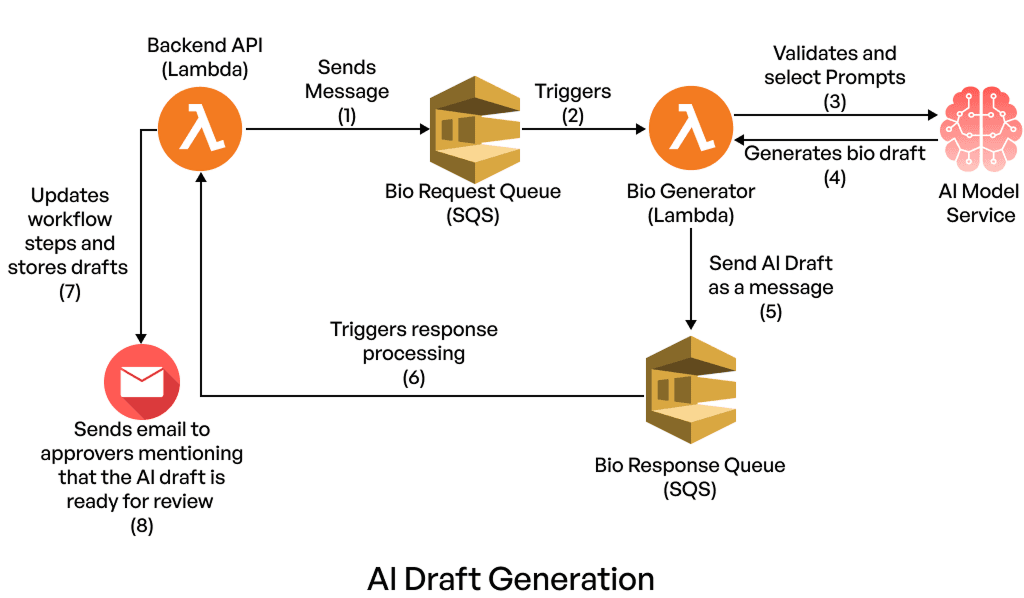
To ensure that slow LLM token generation never blocks user-facing application performance, inputs are pushed to cloud queues for asynchronous execution. An AI model processes the structured records, referencing external, YAML-based prompt templates managed by administrators. The engine instantly maps and rewrites raw clinician data into high-quality, patient-centered professional narratives.
Phase 3: Automated Review & Approval Cycle
A custom backend state machine manages the multi-step stakeholder approval chain. The system handles active on-screen commenting, tracks complete version lineages, and relies on built-in cloud event bridges to trigger scheduled email reminders, preventing stale review queues.
Key Features and Technical Highlights
- Decoupled Asynchronous Processing: Isolates heavy AI generation workloads from core API requests to guarantee crisp, zero-latency user interfaces.
- Externalized Prompt Engineering: Prompts are organized in clean YAML configurations, allowing communications teams to tune the AI’s tone and style without redeploying core application code.
- Hardened Healthcare Data Integrity: Secured with strict Role-Based Access Control (RBAC), cloud-native secrets management, and SHA-256 message hashing to protect data transmission pipelines.
- Comprehensive Audit Trails: Automatically logs every single state transition, message exchange, and administrator approval decision with precise, non-repudiable timestamps.

Impact
- 55% faster turnaround times: Cut the average bio publication cycle from nine business days to just 4, completely eliminating the "blank-page" problem.
- 60% lower provider burden: Reduced initial input times from 30 minutes to 10–12 minutes per bio, maximizing engagement from time-constrained clinicians.
- 42% higher first-pass quality: Improved content standardization via engineered prompts, successfully dropping major editorial rewrites by 38%.
- 100% on-time SLA visibility: Centralized all requests into one dashboard, which decreased administrative status-check email traffic by 70%.
- Zero idle compute costs: Provided an event-driven, serverless framework that naturally scales to handle growing healthcare rosters with high cost efficiency.
Client Profile
Challenges
QBurst Solution
Technical Highlights
Impact