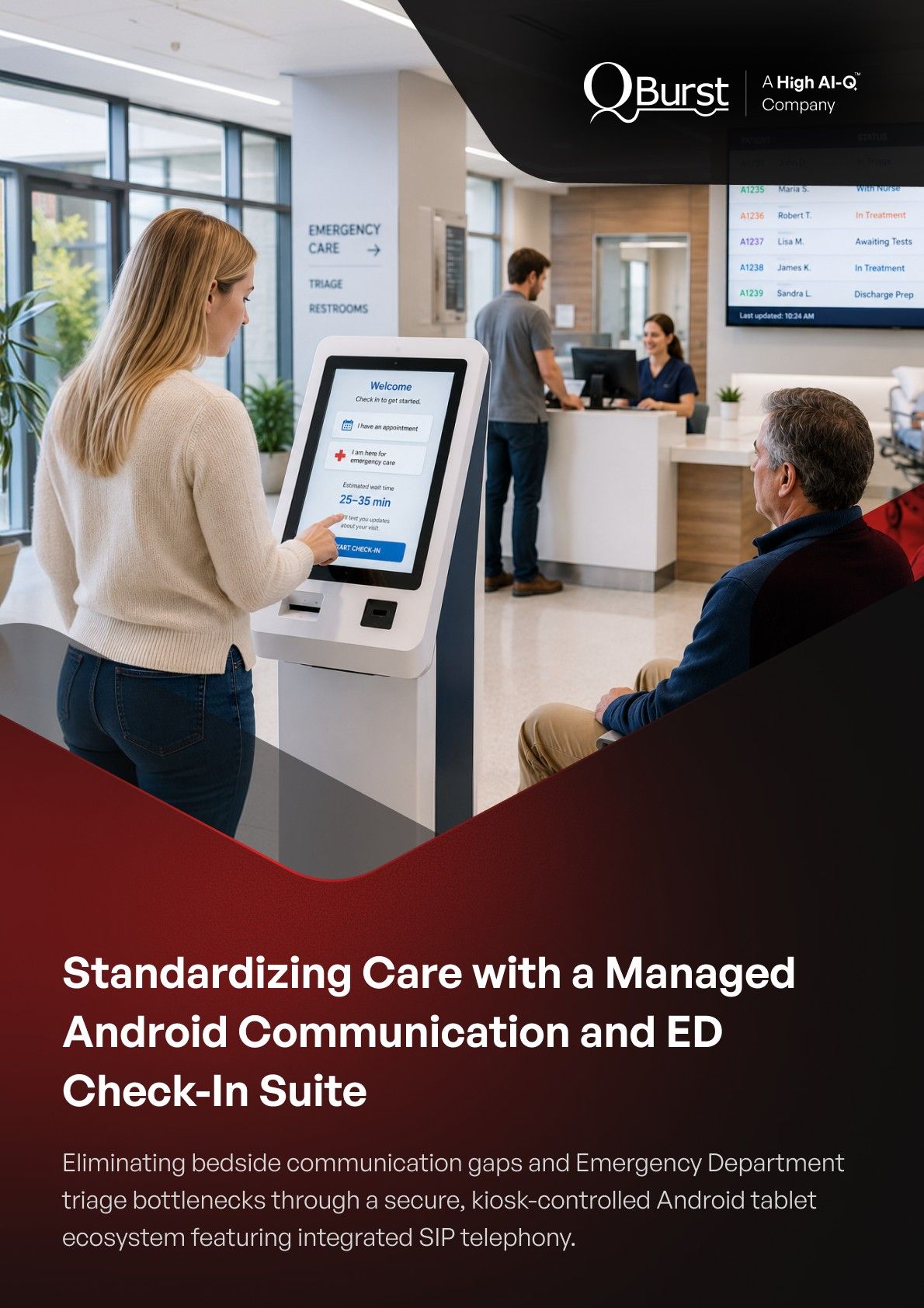
Eliminating bedside communication gaps and Emergency Department triage bottlenecks through a secure, kiosk-controlled Android tablet ecosystem featuring integrated SIP telephony.
One of the premier academic medical centers and integrated health systems in the United States, globally recognized for excellence in patient care, clinical research, and medical education.
Fragmented inpatient communication tools, manual Emergency Department (ED) triage intake, and inconsistent tablet configurations across shared hardware led to operational overhead, care delivery delays, and an uneven experience for both patients and clinicians.
We engineered a unified, enterprise-managed Android tablet application suite tailored specifically for shared clinical environments and high-throughput emergency care.
This prominent US academic health system operates multiple inpatient facilities and specialized outpatient centers. Driven by a large workforce of healthcare professionals, researchers, and educators, the organization leverages technology-driven innovation to establish cutting-edge benchmarks for medical workflows and patient-centered hospitality.
Deploying consumer-grade mobile hardware into a high-stakes hospital ecosystem introduced critical operational friction:
We designed and developed an end-to-end suite of managed Android applications optimized to run seamlessly on the hospital’s fleet of shared tablets. The architecture balances clinician oversight, patient accessibility, and ironclad IT control.
The deployment unifies separate care workflows into specialized digital tracks:
Constructed a secure, web-linked workflow that allows clinicians to initiate immediate high-definition video sessions directly to designated patient tablets. This facilitates rapid virtual rounding and patient evaluation; to prevent disruption, the session control is strictly clinician-led, meaning patients receive and join rounds but cannot initiate outbound video calls. Simultaneously, we built a Session Initiation Protocol (SIP) telephony layer, assigning dynamic telephone numbers to bedsides so patients can place outbound calls to loved ones or handle incoming phone traffic seamlessly.
Engineered a lightweight, guided check-in application tailored specifically for the extreme high-throughput pressures of the Emergency Department. The interactive interface walks incoming patients through an intuitive registration flow, mapping intake parameters directly into backend databases to dramatically lower wait times.
To preserve enterprise security, the entire application stack is locked down using custom Android kiosk configuration parameters. This software-defined shield isolates the operating system, restricting the hardware entirely to approved clinical applications. A standalone administrative utility app was deployed alongside the suite, enabling on-floor medical staff to quickly reset configurations, standardize local tablet settings, and verify device readiness between patient rotations.
Client Profile
Challenges
QBurst Solution
Technical Highlights
Impact