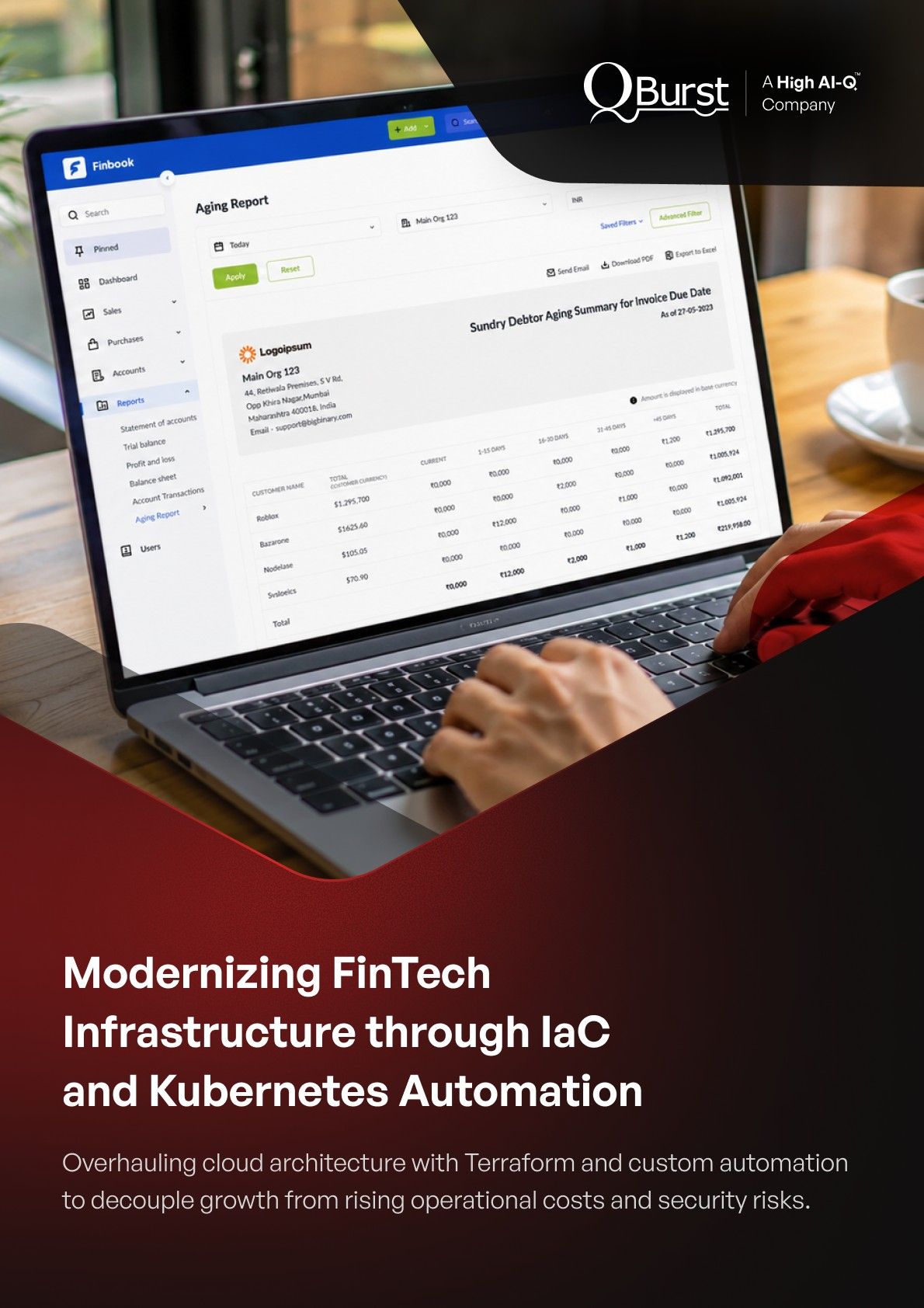
Modernizing FinTech Infrastructure through IaC and Kubernetes Automation
Overhauling cloud architecture with Terraform and custom automation to decouple growth from rising operational costs and security risks.
Client
A proprietary SaaS provider of advanced online accounting and consolidated financial reporting software.
Problem Statement
The client faced excessive cloud costs ($1500+/month), inconsistent environments, and manual deployment bottlenecks that hindered scalable growth and security.
Industry
Quick Summary
We initiated a comprehensive cloud overhaul transitioning from manual configurations to a version-controlled, auditable infrastructure.
- Reduced monthly cloud spending by 30% by re-architecting environments and replacing redundant EKS clusters with cost-effective alternatives.
- Streamlined the development lifecycle by replacing fragile shell scripts with a custom Python-based CLI, accelerating time-to-market and operational efficiency.
Client Profile
Based in the FinTech sector, the client offers a modern SaaS accounting platform. It specializes in high-complexity reporting, enabling businesses to integrate accounts from multiple branches with up to 10 nested levels for consolidated financial statements.
Challenges: High Overhead and Architectural Drift
The legacy infrastructure was a fragile mix of technologies that could no longer support the product's expansion:
- Excessive Spending: Monthly costs exceeded $1,500 due to redundant Amazon EKS clusters for both production and staging.
- Environment Inconsistency: Disparate setups across development (Docker) and staging/production (EKS) led to frequent deployment failures and difficult troubleshooting.
- Operational Friction: Reliance on manual configurations and complex microservice workflows slowed development cycles and increased human error.
- Security Vulnerabilities: Outdated software and inconsistent patches exposed the platform to significant risks.
QBurst Solution: Automated IaC and Optimized Kubernetes Strategy
We implemented a secure, automated foundation centered on modern DevOps principles. Our strategy focused on migrating the entire infrastructure to code and optimizing environment parity without the high cost of managed services for non-production workloads.
- Infrastructure as Code (IaC): Utilized Terraform to define all AWS resources, ensuring that networking, security groups, and clusters are repeatable and drift-free.
- Strategic Re-architecture: Migrated the staging environment from Amazon EKS to a self-managed Kubernetes cluster on EC2 using Kubespray, maintaining production parity at a fraction of the cost.
- Custom Automation: Developed a Python-based CLI tool to standardize CI/CD processes, empowering developers to manage microservices and deployments independently.
- Modernized Development: Moved development to standardized EC2 instances with defined networking, replacing isolated internal servers for a more stable experience.
Technical Highlights
- End-to-End Terraform Management: All cloud resources, from subnets to clusters, are version-controlled and auditable.
- Cost-Optimized Staging: Leveraged Kubespray on EC2 instances to achieve EKS-like functionality with lower overhead.
- Developer Empowerment CLI: A custom interface for microservice management, testing, and one-touch deployments.
- Hardened Security: Standardized patching and security best practices enforced through automated code reviews and latest-version upgrades.
Impact
- 30% Cost Reduction: Strategic environment re-architecture significantly cut monthly AWS expenditure.
- Enhanced Reliability: A consistent, code-defined foundation eliminated "works on my machine" issues and enabled seamless scaling.
- Faster Time-to-Market: Standardized CI/CD pipelines allow for more frequent, reliable, and secure feature releases.
- Operational Agility: Engineering resources shifted from manual maintenance to product innovation, reducing the risk of human error.
Client Profile
Challenges
QBurst Solution
Technical Highlights
Impact