
-1774417345086.jpg)
Re-Engineering Facilities Management with Dynamics 365

Facilities management operates in an environment where timing and coordination are critical. A sudden change in weather, an unexpected surge in service requests, or a missed contract renewal can quickly disrupt operations. When these signals are managed across disconnected systems, even small delays can escalate into SLA breaches, customer dissatisfaction, and financial risk.
Yet many organizations still rely on spreadsheets, emails, and siloed tools to manage daily operations. While familiar, these systems create fragmented workflows that slow decision-making and limit visibility across the service lifecycle.
In this article, we explore how we helped a large organization that manages facilities address these challenges by transitioning to a unified, event-driven operational platform built on Microsoft Dynamics 365.
What is in this article?
- The operational challenges caused by disconnected systems
- How a unified platform coordinates weather, service requests, contracts, and compliance
- A practical architecture for building a real-time operations platform using Dynamics 365
- How contract onboarding reduced from ~20 to 7 days with full traceability and audit visibility
The Challenge
As the organization grew, its reliance on spreadsheets, email, and document-based workflows began to create significant operational strain. What once worked for smaller volumes became a bottleneck at scale.
Delayed Ticket Processing
Service ticket management was one of the most affected areas. Teams manually reviewed weather forecasts before creating service jobs, leading to delays in responding to changing conditions.
At the same time, incoming service requests, often submitted via email, had to be manually reviewed, categorized, and assigned. As volumes increased, response times slowed, making it harder to meet service-level agreements.
Limited Operational Visibility
Operational data was spread across multiple systems, leaving leadership without a clear, real-time view of ongoing activities. Service escalations were not consistently tracked in a centralized system, increasing the risk of SLA breaches. At the same time, contract lifecycle events such as renewals and expirations required manual monitoring, while administrators spent significant time managing contractor compliance documentation.
As these gaps accumulated, day-to-day operations became harder to coordinate. Teams lacked a unified view of service delivery, contractual obligations, and compliance status, making it difficult to respond quickly and make informed decisions.
The Solution
From a leadership perspective, it became clear that the real issue was not just inefficient processes but the absence of integrated operational systems. The organization needed a platform that could automatically respond to operational triggers while still keeping clear governance and visibility across the whole service ecosystem. To address this, we architected a unified operational platform using Microsoft Dynamics 365, as the client was already within the Microsoft ecosystem.
The Platform Architecture
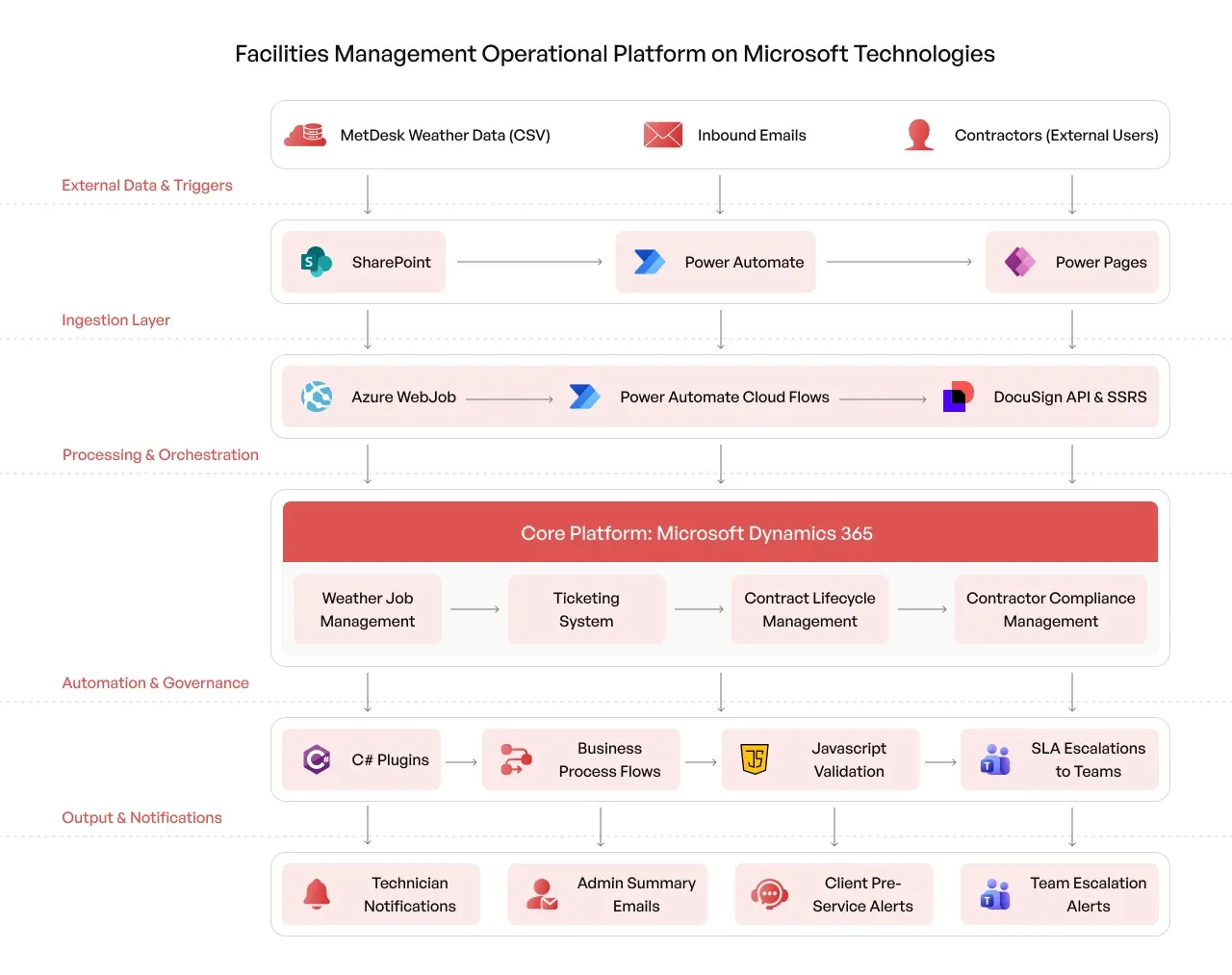
The platform architecture follows a structured event-driven model, and each operational trigger initiates a controlled workflow.
At the center of this architecture is Microsoft Dynamics 365, the primary system of record. Built on Dataverse, the platform structures key entities like contracts, service tickets, jobs, contractors, and compliance records. This creates a governed and reliable data foundation that supports consistent operations across the organization.
Workflow Orchestration
Power Automate acts as the orchestration layer for the platform. It continuously monitors external inputs such as incoming emails, document uploads, and weather forecast files. When these events occur, automated workflows are triggered to create or update records, initiate approvals, notify stakeholders, and enforce business policies.
Performance Processing
For compute-intensive scenarios requiring high-performance processing—such as generating large volumes of service jobs from weather forecasts—the platform uses Azure-based compute services. These services execute optimized logic to evaluate operational rules, validate contracts, and create jobs in bulk while maintaining system performance and reliability.
Document and Contract Management
Structured contract data is converted into formal documents using SQL Server Reporting Services (SSRS). Digital signature platforms are then used to manage secure contract execution and lifecycle updates. This ensures that operational processes reference legally executed agreements before activating service eligibility.
Contractor Access and Compliance
External stakeholders, such as contractors, access the system through secure digital portals built using Power Pages. These portals allow contractors to submit documentation, monitor compliance requirements, and complete onboarding workflows. Automated monitoring ensures that expired certifications or missing documentation immediately affect contractor eligibility.
Governance and Validation
To maintain governance and data integrity, plugins and validation logic enforce key controls across the platform. Operational data remains consistent with business rules and flows smoothly across processes. As a result, the platform delivers greater operational resilience, transparency, and control.
Measurable Impact on Operations
The implementation of a real-time operational platform delivered significant improvements across service delivery and governance.
Faster Service Response
Weather forecasts now automatically trigger job creation, eliminating delays caused by manual planning. Service ticket management also became more structured and transparent, enabling teams to handle higher volumes of requests while maintaining SLA compliance.
Reduced Onboarding Time
Contract onboarding timelines were reduced from approximately 20 working days to just 7, while maintaining full document traceability and audit visibility. Automated reminders and lifecycle tracking ensure that renewals, expirations, and amendments are handled proactively.
Stronger Compliance Control
Contractor compliance shifted from manual administrative oversight to a system-driven governance model. Expired certifications or missing documentation automatically affect contractor eligibility, reducing operational risk and strengthening compliance management.
Complete Operational Visibility
Leadership teams now have clear visibility across operational activities. Instead of relying on scattered spreadsheets and email threads, decision-makers can monitor service activity, contract status, compliance posture, and operational workload through a single unified platform.
The Future Is Real-Time
As operations become more complex and time-sensitive, the need for connected, responsive systems will only grow. A unified, event-driven platform built on Microsoft Dynamics 365 enables organizations to move beyond reactive processes toward real-time, intelligent operations. Organizations that invest in such platforms today will be better positioned to scale, adapt, and lead in an increasingly dynamic environment.