


In automotive Electronic Control Unit (ECU) development, a single mismatch between documentation and the actual software binary can lead to weeks of wasted calibration effort or safety-critical failures.
We recently partnered with our Europe-based automotive client to eliminate this synchronization gap by developing a custom Python-based validation tool that automatically verifies software documentation against the ECU's core technical artifacts: the A2L file, which maps software variables to memory addresses, and the S19 file, which contains the compiled binary logic and values stored at those locations.
What’s in this article:
- The imperative of bridging the gap between compliance records and binary reality
- How we built a Python-based validation tool that eliminates tedious manual verification
- Handling variant-specific logic based on factors like country emissions and safety controls
- How automated validation reduced verification time by 60% and prevented defects before testing
The Cost of Disconnected ECU Documentation
Each ECU software file is managed in an internal system where software and function owners review and approve changes. However, with frequent software updates and dozens of car variants, keeping this documentation synchronized with the actual software becomes increasingly difficult. As a result, some functions may be documented incorrectly as active or inactive.
These mismatches become especially challenging because modern ECUs typically run a common software base across multiple global markets. Instead of maintaining separate software for each vehicle, manufacturers use conditional logic to enable or disable features based on market requirements such as emissions regulations, speed limits, safety standards, and optional equipment.
Every vehicle contains hundreds of software functions, but only a subset is active for a given variant. The ECU determines this at runtime using configuration flags and conditional logic. For example:
1// Example of an Inactivity Check
2if (steering_inact_flag != 0) {
3   run_steering_assist_logic();
4} else {
5   // Function remains inactive for this variant
6   return;
7}
Here, the steering_inact_flag determines whether the steering assist function executes. If the Component Responsible (BTV, from the German Bauteilverantwortlicher) incorrectly records the state of this flag in the internal tracking system, the documentation no longer reflects the behavior of the software binary. A function may be documented as active while the ECU disables it at runtime, or vice versa.
Our Approach: Automated Logic Validation
To eliminate manual verification and improve documentation accuracy, we developed a custom validation tool centered around the Inactive Function Manager.
Using the Inactive Function Manager, the BTV configures validation rules through a simple interface that presents only the functions and parameters relevant to the selected vehicle variant. This reduces unnecessary navigation and helps engineers focus on the specific logic flags that determine whether a function should remain active or inactive.
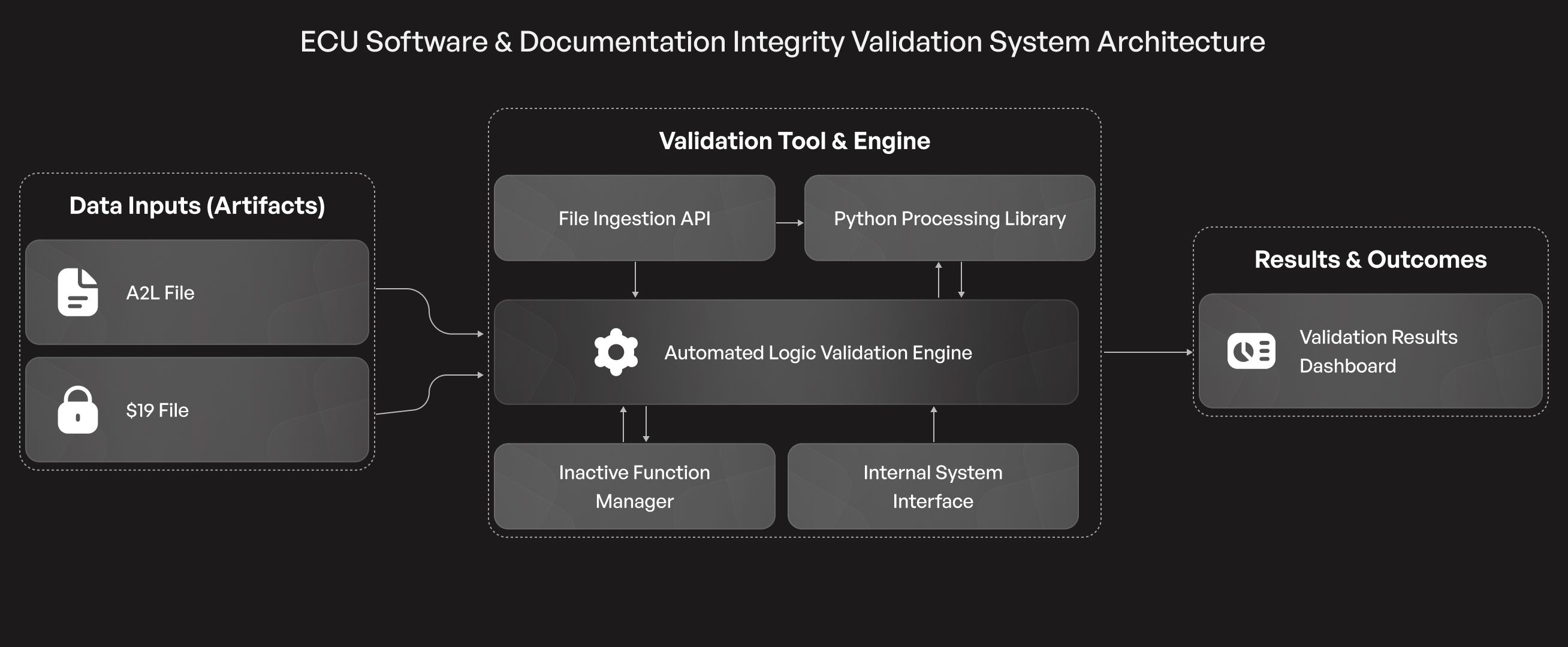
Each configured rule captures the expected condition for a function and is stored as part of the validation configuration. For example:
| Function Name | Inactivity Parameter & Condition | Value |
| Steering_Assist | steering_inact_flag != | 0 |
| Cruise_Control | cruise_enable_flag = | 1 |
These saved rules become the reference point for the automated validation engine.
Validation Workflow
The validation process consists of four steps:
- File Ingestion: The system integrator or control unit responsible uploads the ECU software files (A2L and S19) directly into the tool.
- Automated Validation: The tool automatically pulls the saved logic conditions from the Inactive Function Manager and compares them against the real data in the uploaded files.
- Review: Clicking “Run Check” triggers an automatic comparison between documented and actual software functions.
- Mismatch Handling: The tool highlights any mismatches and allows users to export reports for follow-up.
The application uses Python for backend processing and JavaScript for the frontend, connecting securely to internal systems via APIs. We implemented robust data processing, including duplicate removal and proper signal-to-value mapping based on relevant datasets.
Validation Results Dashboard
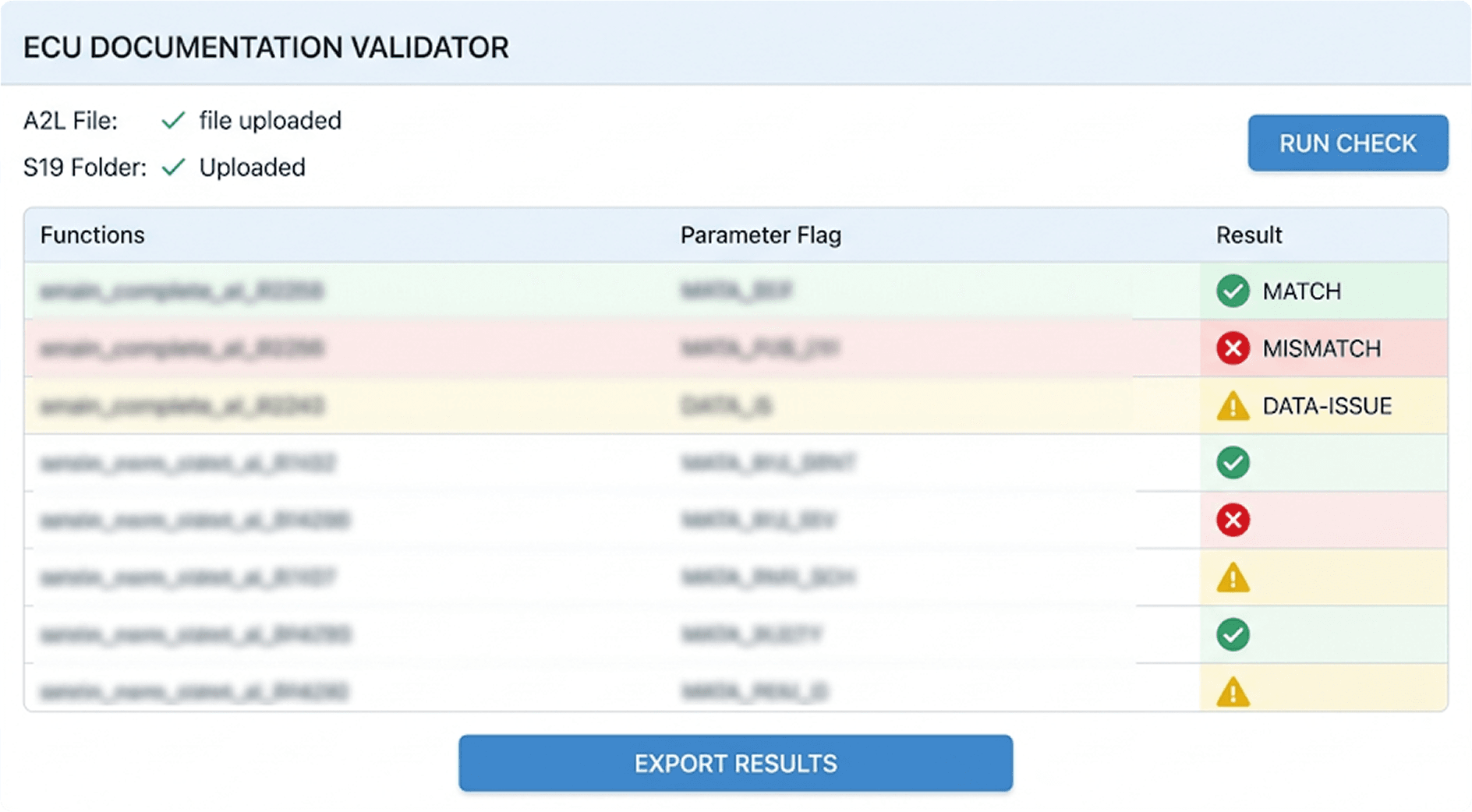
Once validation is complete, the tool presents a dashboard comparing the documented logic with values extracted from the A2L and S19 files. This gives engineering teams a clear view of whether each documented condition accurately reflects the software, making it easier to identify issues before calibration or testing begins.
When discrepancies are detected, the affected rows are marked as Mismatch. If validation cannot be completed because required data is unavailable (such as a missing flag in the A2L file), the tool reports it as a Data Issue.
| Parameter Flag | Documented Condition | Actual File Value | Status |
| steering_inact_flag | != 0 | 1 | Mismatch |
| cruise_enable_flag | = 0 | 0 | Matched |
Outcomes at a Glance
The transition to automated validation delivered immediate and measurable benefits across the entire ECU development lifecycle:
- Higher Accuracy: Documentation now reflects the actual state of the ECU software, eliminating many inconsistencies introduced by manual updates.
- Increased Efficiency: Manual verification time was reduced by over 60%. Automating the comparison process allowed the engineering team to move away from tedious spreadsheet-based checks and focus on high-priority development and system optimization.
- Earlier Defect Detection: Logic mismatches are identified before calibration and testing, preventing downstream performance issues and reducing release risk.
- Greater Release Confidence: Automated validation reports provide documentation, calibration, and software teams with a common source of truth, making release decisions more reliable.