
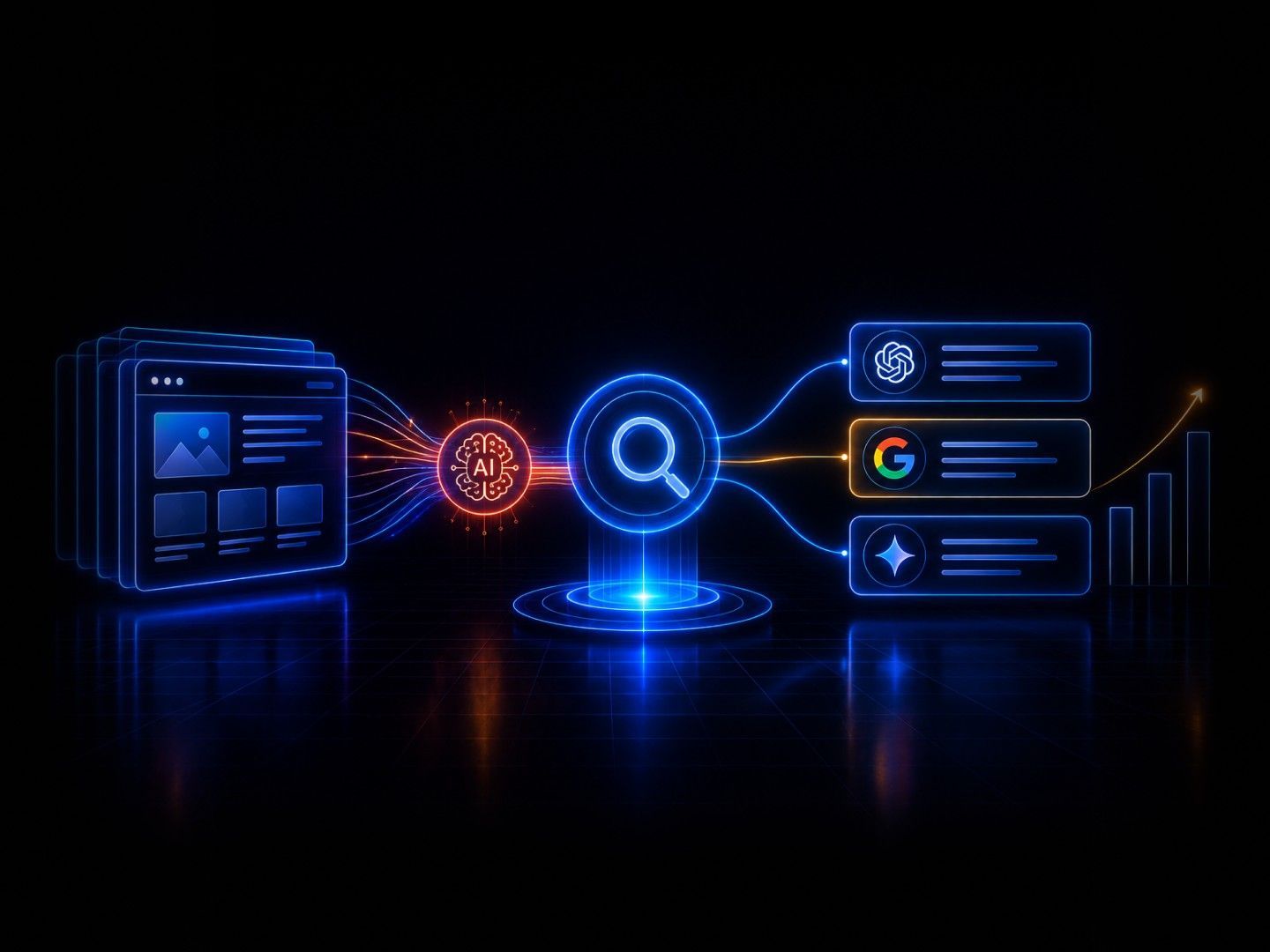

Your website ranks well, attracts consistent organic traffic, and supports a mature SEO strategy. Yet when customers turn to ChatGPT, Google AI Overviews, or other AI-powered search experiences, your brand is nowhere to be found.
A March 2026 survey by G2, published in The Answer Economy: How AI Search Is Rewiring B2B Software Buying report, found that 51% of B2B software buyers now start their research with an AI chatbot more often than with Google. Meanwhile, 94% of B2B buyers surveyed reported using generative AI during their buying process. When AI-powered search experiences leave your brand out of their answers, you may not make it onto the buyer's shortlist before a single link is clicked.
An AI Search Readiness Audit can help identify visibility gaps, diagnose root causes, and prioritize improvements that strengthen your presence across AI-powered search experiences.
What's in this article:
- What is an AI Readiness Audit, and how does it work?
- How can AI Search Readiness Audit findings be prioritized and turned into action?
- How do SEO, AEO, and GEO work together to support AI search visibility?
How SEO, AEO, and GEO Work Together
AI search visibility builds on many of the same foundations as traditional SEO, with added emphasis on how clearly information can be understood, retrieved, and represented.
- Search Engine Optimization (SEO) improves site structure, content, metadata, and authority signals so search engines can crawl, index, evaluate, and rank pages in search results.
- Answer Engine Optimization (AEO) structures content around clear questions, entities, and concise responses so answer engines can identify, extract, and surface relevant answers.
- Generative Engine Optimization (GEO) strengthens content, context, and supporting signals to help generative AI systems understand, reference, and more accurately represent an organization and its expertise in AI-generated responses.
These areas overlap rather than operate independently. An AI Search Readiness Audit looks at how effectively these elements work together across the website.
What Is an AI Search Readiness Audit?
The audit typically draws on SEO Audit tools such as Semrush, Ahrefs, Google Search Console, and Screaming Frog, along with AI visibility platforms such as Semrush AI Toolkit, Peec AI, and Profound. It may also incorporate website analytics, search performance data, and structured data testing, depending on the scope of the audit.
However, tool output is only the starting point. The broader goal is to evaluate five structural pillars to assess whether your website presents a clear, connected, and consistent picture to search engines and AI systems.
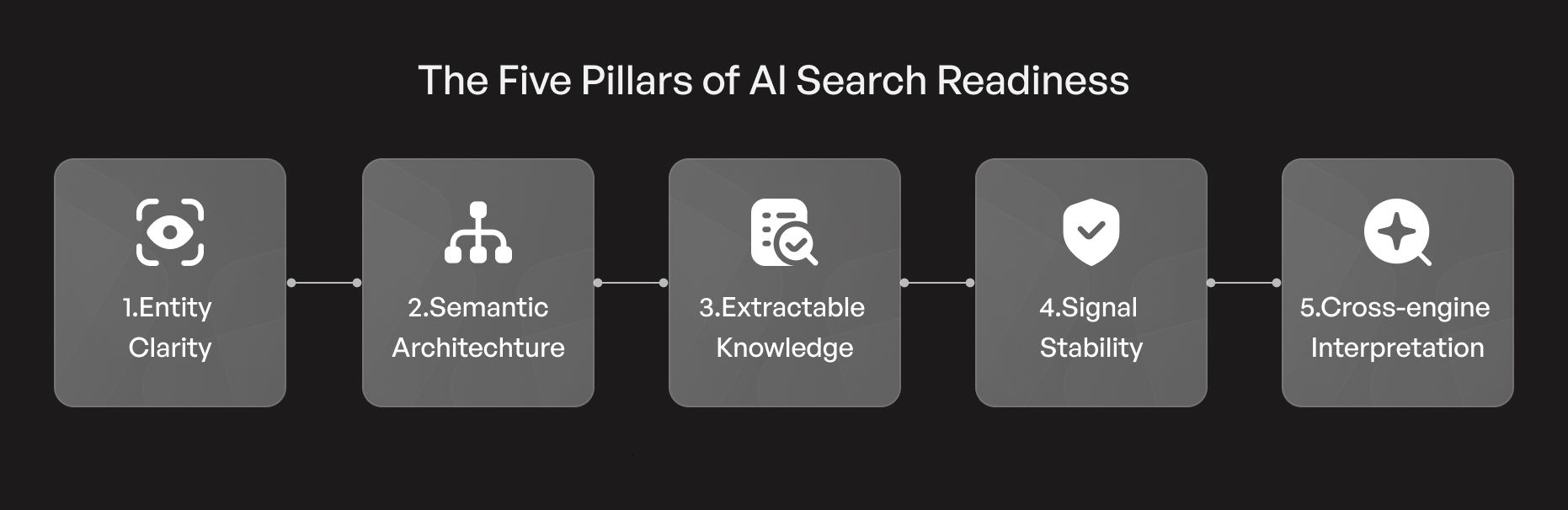
1. Entity Clarity
Enterprise websites often describe their services differently across regions, business units, and product and service pages. Some differences are intentional, such as emphasizing services that are more relevant to a particular region or customer market. However, conflicting or outdated information can make it harder for LLMs to form a clear picture of the organization, its offerings, and its expertise. Aligning key service descriptions and structured data helps reinforce a clear, unified representation of the brand.
2. Semantic Architecture
Even strong content can lose visibility when related information is scattered across disconnected pages. The audit assesses internal linking, page hierarchies, topic clusters, and relationships between related pages. These connections help search engines and AI systems understand how your services, expertise, supporting evidence, and related topics fit together.
3. Extractable Knowledge
Content also needs to be structured so search engines and AI systems can more easily parse, identify, and retrieve relevant details. Clear answers, explanations, supporting evidence, well-structured heading hierarchies, introductory summaries, and organized lists can make important information easier to identify and retrieve for relevant queries. This is where AEO becomes particularly important: not simply publishing more content, but making valuable information easier to locate and understand.
4. Signal Stability
Page content, navigation, metadata, structured data, headings, and business information should reinforce the same message. When those signals conflict or become outdated, they can create ambiguity and make the organization harder for AI engines to interpret consistently. This is a common challenge on large websites managed across multiple teams or markets.
5. Cross-Engine Interpretation
Because visibility varies across traditional search results, AI-generated search experiences, and conversational platforms, evaluating where your brand appears and where there are citation gaps is crucial. The audit benchmarks your AI search visibility against competitors, analyzing which pages and sources surface to identify weaker topics or website areas.
Together, these five pillars show whether the website is accessible, its information is connected and extractable, and your organization is represented consistently across AI-powered search.
How Audit Findings Are Prioritized and Turned into Action
An AI Search Readiness Audit is less about unearthing a massive list of errors or gaps and more about understanding why they exist and deciding what to fix first.
In our client engagements, we move systematically from observation to measurement. We start by pinpointing exact visibility gaps (Observation), such as an enterprise service page ranking on page one of Google but completely vanishing inside ChatGPT summaries. We then determine why that gap exists (Diagnosis), whether it stems from fragmented content, inconsistent schema signals, or other underlying issues.
Before writing a single line of code, we assess the commercial risk (Business Impact) on traffic and evaluate the urgency of each finding to determine what needs attention first (Priority). This helps engineering teams focus on high-impact technical fixes first. From there, we deliver explicit specifications (Recommendation), partner with teams to execute changes across technical and semantic layers (Implementation), and monitor generative engine citations (Measurement) to evaluate changes in visibility.

Why Data Still Needs Expert Analysis
Tools can highlight potential issues, but they cannot evaluate the business context.
Suppose a competitor is cited more often for an important group of queries. The reason could be broader topical coverage, clearer page relationships, better supporting evidence, stronger authority signals, or content that more closely matches those particular questions. Each cause requires a different response.
Similarly, missing structured data on a low-value page may have little practical impact. On the other hand, contradictory service definitions across a few high-value pages can eliminate your brand from enterprise vendor comparisons.
A raw finding merely indicates where to investigate. Determining what that finding means and whether it warrants engineering resources requires human expertise. Expert analysis brings the context together to identify root causes, determine which findings matter most, and recommend where teams should focus their efforts. This broader perspective is where digital marketing expertise adds value—connecting technical SEO, content, search performance, and business priorities to turn audit findings into action.
In other words, tools show where to investigate; expert analysis determines what the findings mean and what should happen next.
Connect with our digital marketing specialists for an AI Search Readiness Audit. We will help you uncover hidden visibility gaps and build a practical plan to ensure your business gets recommended when buyers research options.