


Traditional Just-in-Time (JIT) replenishment works well for canned goods and electronics, but fresh produce is a different beast. Variable shelf life, dynamic supply chain shifts, and unpredictable local demand turn standard inventory formulas into a constant trade-off between empty shelves and rotting stock.
By replacing static ordering with a dynamic Store × SKU forecasting model, retailers can stabilize supply flows and protect grocery margins.
What's in this article:
- Why standard JIT replenishment fails in fresh food categories
- How localized data models balance demand, shelf life, and delivery variances
- How a major US retailer cut produce waste by up to 20% and store ordering effort by 30%
- Upgrading from deterministic rules to probabilistic demand forecasting
When Legacy Just-in-Time Replenishment Models Don’t Work
Standard reorder formulas work well for shelf-stable goods, but fresh produce face six operational complexities:
- Varying Shelf Life: Highly perishable items (for example, berries) require fundamentally different coverage windows than apples or potatoes.
- Fluctuating Demand: Weekends, holidays, weather changes, promotional campaigns, and local events radically alter purchasing patterns.
- Shrinkage & Waste Management: Order calculations must factor in unsellable waste alongside actual customer purchases.
- Diverse Procurement Units: Inventory tracking is complicated by items being purchased across various metrics, such as cases, pounds, or individual units.
- Item Substitution: Out-of-stock items (for example, strawberries) force dynamic shifts to alternatives (for example, blueberries).
- Supply Volatility: Weather conditions, transport delays, and harvest yields make supplier delivery times unpredictable.
Our Solution for a Major US Discount Retailer
Our client, a leading retailer, operates under a decentralized franchise structure, empowering local operators to manage daily store operations, merchandising, marketing, and customer service. To support this environment, we developed a specialized JIT produce ordering model that generates Store × SKU-level order recommendations by evaluating demand, inventory, delivery schedules, and supply schedules.
Core Capabilities
Coverage Forecasting
The model estimates the inventory required to cover projected demand through the next scheduled delivery cycle. The calculation considers forecast demand, current inventory, incoming inventory, delivery timing, and required operational buffers.
Delivery Variance Adjustment
The model compares ordered quantities with actual delivered quantities. When deliveries are shorted or over-supplied, the variance is incorporated into subsequent replenishment decisions so that future recommendations reflect actual supply performance rather than assuming that every order is fulfilled exactly as planned.
Supply Smoothing
The model evaluates supply and inventory deviations across multiple ordering cycles rather than reacting independently to each delivery variance. This helps reduce order volatility and stabilize inventory flows when short shipments or excess deliveries occur.
Tech Stack
The JIT produce ordering platform is incorporated into an existing application called Store Portal used for Store operations and reporting.
Frontend: React
The user interface is developed using React, providing a responsive and intuitive experience for store operators and administrators. The frontend is responsible for executing the JIT order-optimization logic, calculating recommended order quantities at a Store x SKU level for each order-delivery window. The UI communicates with the backend through secure REST APIs.
Backend: .NET Core
The core application services are built using .NET Core, providing a robust platform for implementing the JIT business logic and optimization workflows. The backend is responsible for exposing APIs to the React application and external systems and managing authentication, authorization, logging, and auditing. The service-oriented backend can be scaled horizontally as transaction volumes and the number of stores and SKUs increase.
Integration Layer
The platform integrates with the existing ERP system(SAP) for sales and transaction data and the internal Buyer Portal application for item data, through APIs.
Key System Inputs and Output
To calculate accurate replenishment recommendations, the engine processes four primary inputs across every ordering cycle:
- Demand Forecast: Derived from historical sales data with flexibility for manual adjustments.
- Lead Time Schedules: Defined by specific ordering and delivery windows.
- Inventory Metrics: Tracks current on-hand and incoming on-order quantities, also accounting for damaged or unsellable stock.
- Safety Stock: Buffer stock required to absorb sudden demand spikes or short shipments.
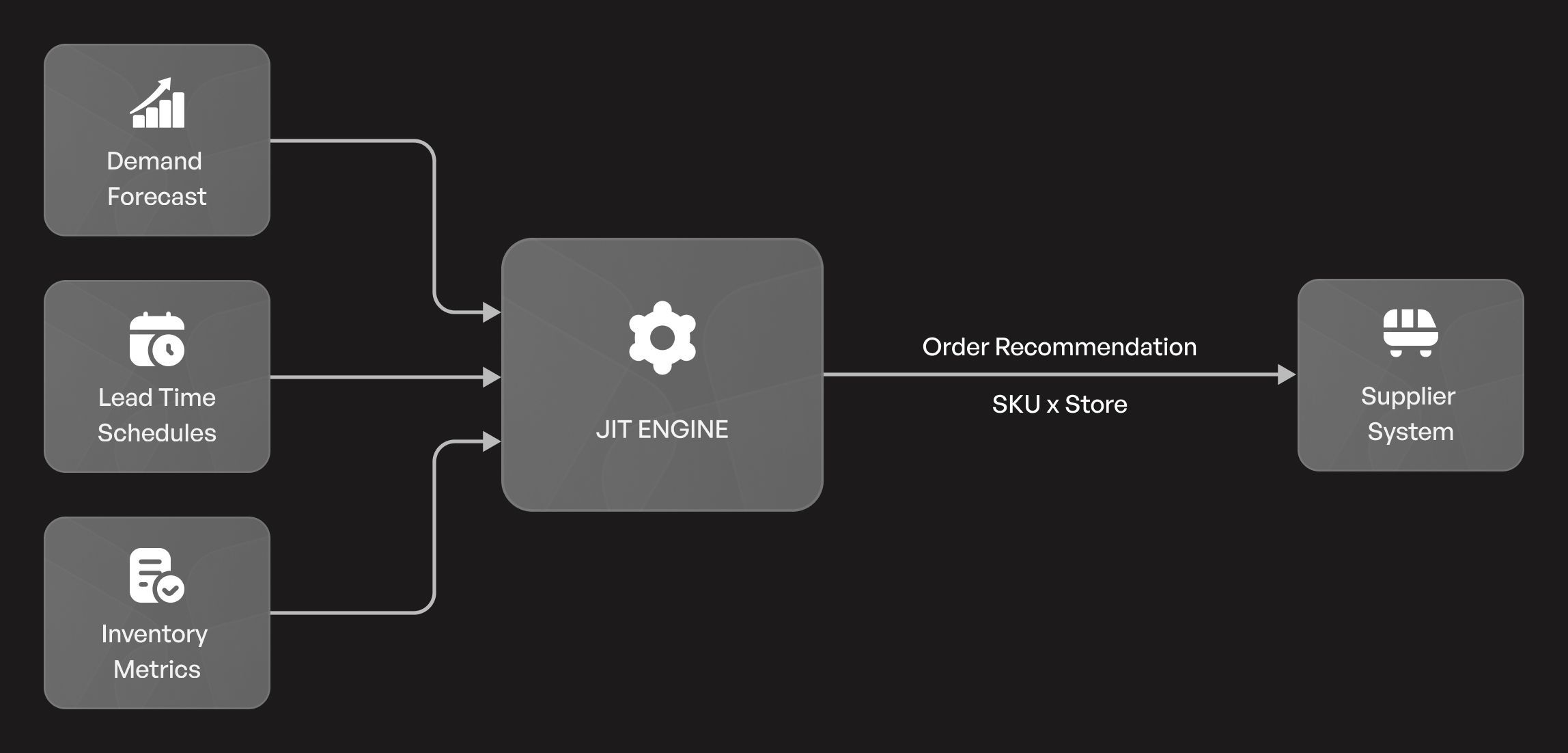
The primary output is a recommended order quantity for each SKU at each store across scheduled ordering days. It answers one clear operational question for store managers every morning: How much should this store order today to maintain appropriate product availability until the next replenishment opportunity?
Measurable Value: Lower Waste, Higher Margins
Moving from manual estimations to data-driven Store × SKU replenishment delivered immediate financial returns across four key operational metrics:
- 10% to 20% Reduction in Produce Waste: Aligning order volumes directly with commercial viability cuts spoilage, markdowns, and disposal costs.
- 5% to 10% Fewer Stockouts: Precise coverage forecasting keeps high-margin inventory on displays without overstocking the backroom.
- 20% to 40% Less Store Ordering Effort: Automated recommendations enable the store teams to focus on store operations and customer service.
- Optimized Working Capital: Eliminating unnecessary safety stock frees up working capital and maximizes refrigerated storage capacity.
The Path Forward for Perishable Supply Chains
Transitioning from a rigid reorder model to a Store × SKU replenishment framework gives multi-unit and franchise retailers a clear operational advantage. It provides corporate teams chain-wide inventory consistency without stripping store managers of local decision-making authority.
The value extends far beyond decentralized franchises. This data-driven approach is equally effective for regional supermarket chains facing unpredictable supplier delivery windows, convenience networks operating with limited backroom cooler space, and Quick-Service Restaurant (QSR) chains managing short shelf-life ingredients across daily routes.
To execute this transition successfully, organizations should focus on three strategic priorities:
- Adopt Exception-Based Operations: Instead of requiring store operators to calculate complex order quantities manually every morning, provide automated, data-backed recommendations. This shifts the manager’s role to reviewing anomaly alerts and managing unusual local demand spikes.
- Factor in Supplier Delivery Realities: Incorporate historical vendor variance directly into the replenishment calculations. Systems that assume 100% vendor order fulfillment inevitably create systemic, predictable stockouts on the retail floor.
- Bridge Procurement Unit Disconnects: Ensure system architecture seamlessly translates bulk supplier ordering metrics (such as cases or pallets) directly into store-level inventory metrics (such as pounds or individual units) to eliminate conversion errors.
Once the foundational JIT model is in place, it sets the stage for the next phase of supply chain maturity: a fully adaptive optimization platform. By layering in probabilistic demand forecasting and predictive supplier reliability, retailers can shift from simply managing inventory to mastering the inherent uncertainty of fresh produce. Ultimately, building this engine empowers store operators with the data they need to maximize freshness, protect margins, and ensure product availability.
Ready to optimize your supply chain and eliminate inventory waste? Explore our tailored digital solutions for the retail industry.