


Decisions about whether a development program gets funded, continued, or reworked depend on how it is evaluated. Historically, that evaluation required a reviewer to read a dense program plan and rate it against agency criteria—a process that took 4 to 5 hours and cost $30 to $35 per review.
Because ratings rely on subjective judgment rather than fixed calculations, two reviewers could score the same program plan differently. This created inconsistency in funding decisions. Manual processing also failed to scale: during submission spikes, review queues backed up, delaying critical funding and operational decisions across the organization.
We built an automated program evaluation application to solve this bottleneck. Operating live today within a prominent global non-profit agency, the platform standardizes program plans into consistent scoring, cutting review times to roughly an hour (75% faster) and lowering costs per review to $20 to $25 (30% cheaper). Agency leadership reports the system saves millions of dollars annually.
What's in this article:
- How a live multi-agent AI application delivers consistent program plan scoring while slashing costs by 30%
- The Azure, LangGraph, and FastAPI architecture that handles complex document parsing and scaling challenges
- How automated backups and parallel processing protect review data during peak submission spikes
Evolving from Proof of Concept to Production Scale
The system evolved through two development phases, from a basic technical test to a production-grade solution.
Phase 1: Proving Multi-Agent Capabilities on Complex Documents
The first phase had one job: prove AI could handle the complex logic needed to read and rate nuanced institutional text. A few things came out of that trial.
The team set up a collaborative system of AI agents using LangGraph, then split model duties: one for the heavier reasoning work of extracting ratings and another for writing descriptive comments.
Getting the models to actually read the documents took some figuring out. Reports include tables and color-coded charts, and a text-only parser flattens all of that into plain text, losing the very signal the rating depends on. Converting those sections into images instead lets the models interpret them without losing context. On top of that, we built a standardized rating logic by working backward from historical human ratings, comments, and agency guidelines.
Phase 2: Scaling for High-Volume Operations
Getting to daily operation meant rebuilding the core engine as a scalable microservice with parallel processing. Accuracy improved too, past an 80% target across every evaluation question, for both score distribution and generated text, though getting there took several rounds of tuning against human feedback.
| Metric | Phase 1 (POC) | Phase 2 (Production Live) |
| Processing Style | One-by-one (Synchronous) | Concurrent (Parallel) |
| Avg. Processing Time | 4 to 5 hours | ~1 hour (75% faster) |
| Avg. Cost per Review | $30 to $35 | $20 to $25 (30% cheaper) |
Overcoming the Architectural Challenges
Automating a review process this nuanced introduced four engineering challenges:
- No Fixed Scoring Formula: There was no standardized structure for turning a review into a final score. We worked through this by analyzing historical human ratings across a large set of reports to build a generalized scoring matrix, giving the AI a consistent basis for comparing one report's rating to another's.
- Question-specific Context: Every evaluation question needed its own context. A single generic prompt couldn't cover the range of things reviewers were being asked to judge, so we mapped historical scores against agency guidelines and engineered a separate, tailored prompt per question.
- Risk of Code Sprawl: Giving each question its own hand-built agent would have meant maintaining dozens of nearly identical code paths. The fix was a single reusable LangGraph workflow, with individual agents spun up on the go as each question came through.
- Latency and Model Failures: Running large volumes through Azure OpenAI reasoning models in parallel caused timeouts and failures that simply didn't show up when everything ran synchronously. We added an automated retry mechanism, a stale job checker, and deep fault monitoring to catch hanging tasks before they turned into lost work.
Solution Architecture
-1791954500936.png)
Cloud Architecture
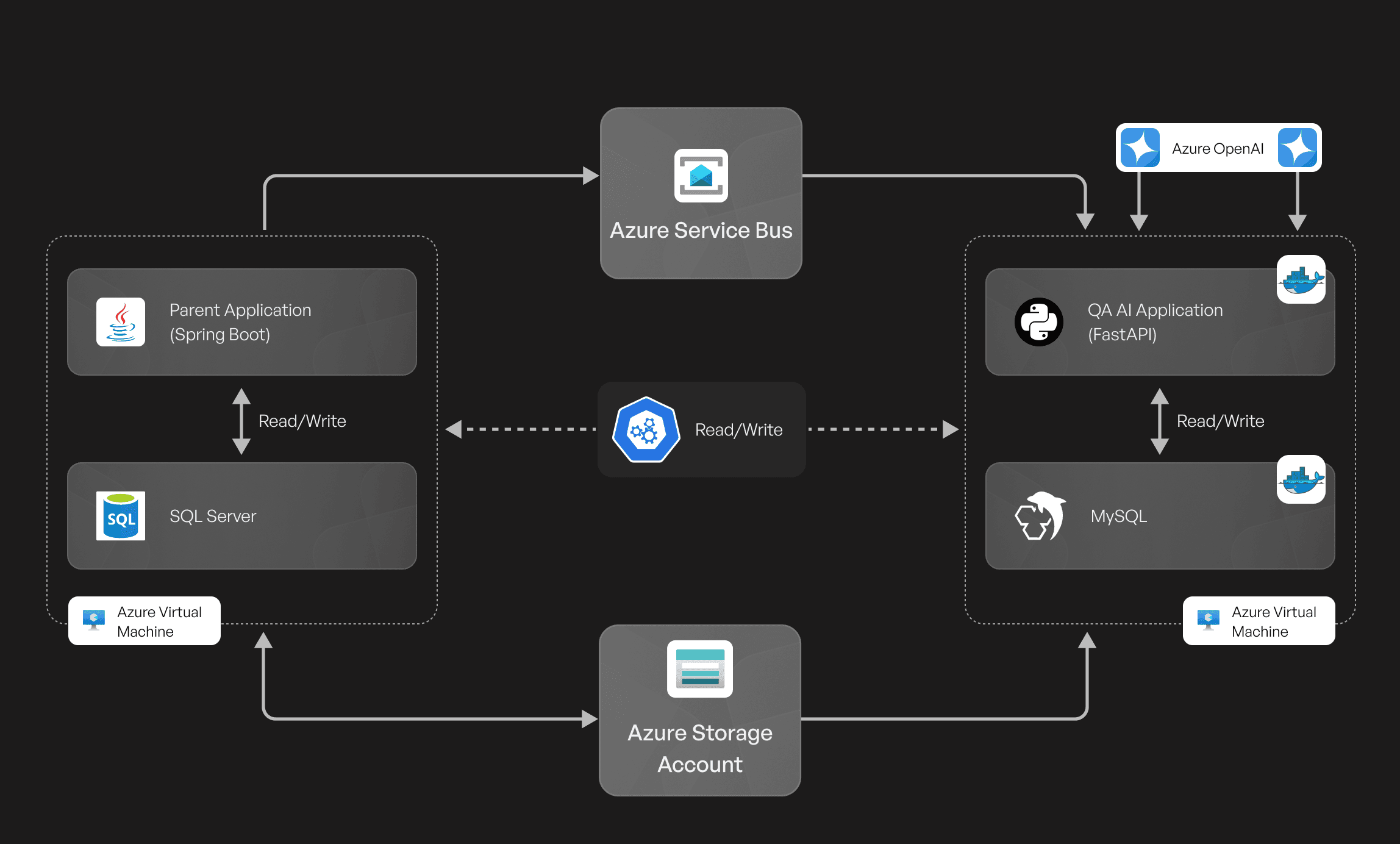
The platform runs on a decoupled cloud architecture hosted on Azure:
- Asynchronous Submission: A user submits an evaluation report through the parent web app; the request goes straight into an Azure Service Bus queue, so the interface stays responsive instead of waiting on the AI to finish.
- Job Persistence: The AI module records the job in a relational database immediately on receipt. Nothing gets lost if the system is interrupted mid-review.
- Optimized Image Handling: Report pages get converted to images to preserve tables and color-coded sections, then uploaded to Azure Blob Storage rather than sent directly through the LLM API. A temporary secure link goes to the model instead, which cuts payload size and speeds things up.
- Multi-Agent Orchestration: FastAPI and LangGraph run the specialized agents concurrently, each grading the document against its own question's criteria.
Enterprise Resilience and Failsafes
Two layers of recovery keep the pipeline running when things go wrong:
- Automated Recovery: If an LLM call times out or hits a network error, the system retries automatically, up to three times. A separate background monitor watches for stale or hanging jobs; if it finds one, it kills the stuck process and spins up a new instance that picks up from the exact point of interruption. Messages that can't be processed get isolated in a dead-letter queue, so the team can investigate later instead of losing them silently.
- Manual Override and Monitoring: If a problem outlasts the automated retries, an authorized user can restart the job with one click from the main portal, while telemetry streams into Azure Application Insights the whole time so developers can see faults as they happen.
Setting a New Standard for Program Evaluation
With the application built and proven in live operation, we are now extending the blueprint to other agencies for their own program evaluation needs. High-scoring evaluations get auto-approved and move through fast; lower-scoring ones get routed back to human coordinators, keeping a person in the loop where judgment still matters.
By replacing manual bottlenecks with parallel processing, the platform transforms localized efficiency gains into an organization-wide standard for global development program assessment.
Ready to modernize your review processes? Reach out to our AI experts.