
Almost every client I worked with uses GitOps religiously. If you read blogs or tech social media, you’d believe that every single company is running the best automated GitOps solution possible. The narrative is the same: convert your cloud resources into Terraform code, commit them to a Git repository, wire up a basic deployment pipeline, and voilà—you have achieved cloud maturity.
Having spent my career in Operations, Systems, DevOps, and Platform Engineering, I can tell you that the reality on the ground is very different.
What’s in this article:
- Why standard IaC deployments degrade at scale
- How to implement a 4-layer dependency model that protects core networking and accelerates deployment velocity
- How a dual-pipeline CI/CD workflow automates security and cost checks before code merges
- How continuous drift detection and Policy as Code prevent manual changes from becoming permanent vulnerabilities
Why “Standard” IaC Implementations Degrade
Dig just an inch below the surface of most IaC implementations, and you will find a familiar web of operational chaos: 15-minute Terraform plan execution times, static AWS Access Keys stored in CI/CD pipeline secrets, and fear-driven deployments where applying a minor change to an application queue risks accidentally tearing down a core VPC.
In my experience working across multi-account AWS environments, infrastructure code degrades due to three fundamental architectural flaws:
The Monolithic State File
When teams first adopt Terraform, they usually create a single repository directory containing a main.tf file that provisions everything: the VPC, subnets, EKS cluster, RDS databases, Redis cache, and S3 buckets. As the environment grows, this monolithic state file becomes a massive liability. A syntax error in an application resource can break or lock the state for the entire network. Furthermore, refreshing state for hundreds of resources during a Terraform plan takes minutes, slowing down feedback loops and encouraging developers to bypass the pipeline altogether.
Partial GitOps and Console Tweaks
Many teams strictly use GitOps for deploying new resources but bypass it for day-to-day operational tweaks. For example, an engineer might manually scale an Amazon RDS instance directly in the AWS console to handle a traffic spike, bypassing the Pull Request review. If a teammate later scales it down manually to save costs, the repository loses its status as the single source of truth. Without codified sizing, there is no peer review or automated schedule, and zero visibility, inevitably leading to outages during the next traffic surge.
Reactive Governance
Security and compliance checks are frequently decoupled from the developer workflow. When security teams run weekly or monthly scans using third-party tools, vulnerabilities like open S3 buckets or a policy violation are flagged after the code merges. Fixing these issues requires retroactive refactoring and costly regression testing. The same reactive pattern plagues cloud spend: an engineer provisions a larger instance or a new managed service to solve a performance issue, and finance only discovers the $400 monthly AWS bill weeks later, forcing an emergency downgrade of live infrastructure.
The Remedy: A 4-Layer Bottom-Up Architecture
If you want to build infrastructure that is truly immutable, scalable, and audit-ready, you must isolate state and decouple dependencies. Rather than dumping resources into monolithic repositories, architect infrastructure from the network upwards using a 4-layer dependency model.
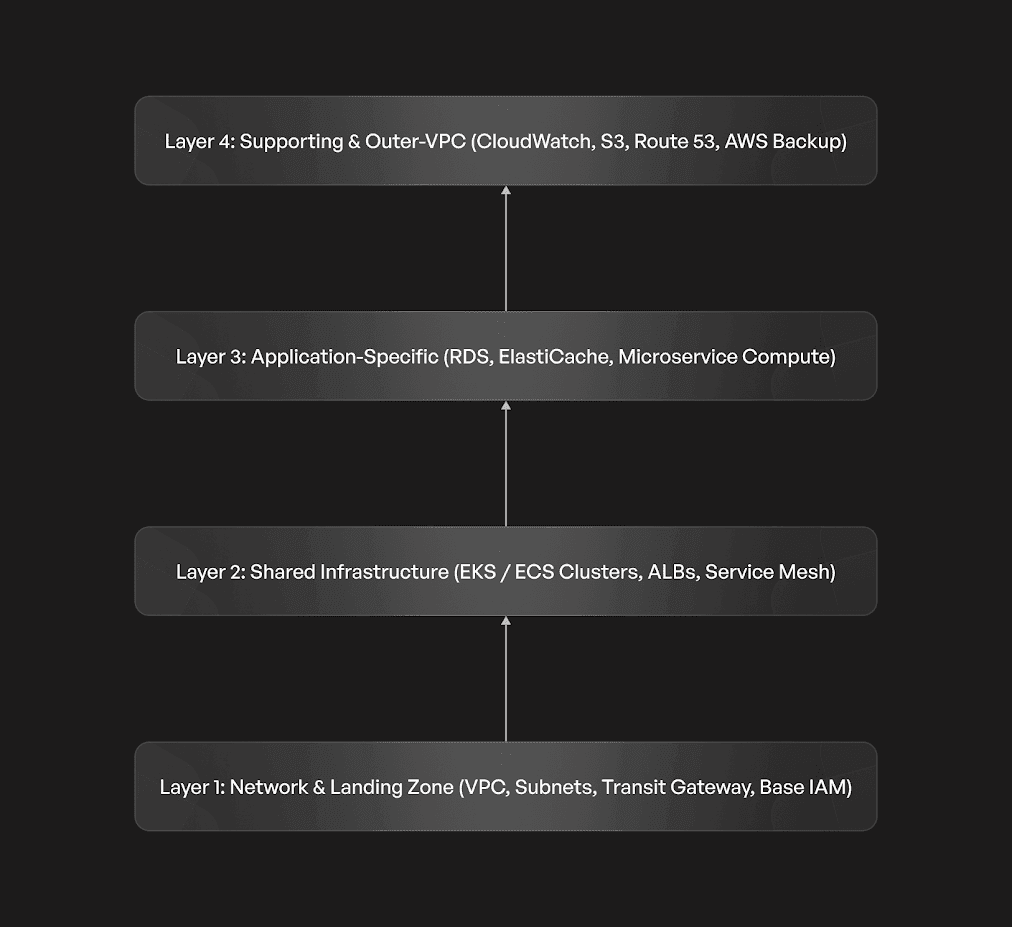
Layer 1: Landing Zone and Core Networking
- Scope: Core VPCs, public/private/database subnets, Internet/NAT Gateways, Route Tables, Transit Gateways, KMS Customer Managed Keys, baseline IAM Identity Center (SSO) permission sets, and central secret store baselines.
- Operational Velocity: Extremely low change frequency. Managed strictly by core platform/networking leads.
- Blast Radius Rule: Changes to Layer 1 should never depend on application code. Higher layers consume Layer 1 outputs (like VPC IDs and Subnet IDs) via remote state references or parameter store lookups.
Layer 2: Shared Platform Infrastructure
- Scope: Shared compute and orchestration control planes—Amazon EKS clusters, Amazon ECS clusters, shared Application/Network Load Balancers, API Gateways, and shared platform security groups.
- Operational Velocity: Medium change frequency (cluster upgrades, node pool scaling).
- Blast Radius Rule: Shared by multiple applications, but decoupled from base networking and application-level database schemas.
Layer 3: Application-Specific Workloads
- Scope: Stateful data persistence and application compute—Amazon RDS instances, Amazon DynamoDB tables, Amazon ElastiCache clusters, microservice ECS task definitions, and application-specific IAM execution roles.
- Operational Velocity: High change frequency. Managed by application DevOps teams.
- Blast Radius Rule: Isolated strictly per service or application domain. To achieve this, every individual application or microservice should ideally maintain its own dedicated Terraform state file. This ensures that a failed deployment or state corruption in Service A’s database code cannot possibly impact Service B or the underlying shared EKS cluster.
Layer 4: Supporting and Outer-VPC Services
- Scope: Observability dashboards (Amazon CloudWatch, AWS X-Ray), global storage buckets (Amazon S3), CDN distributions (Amazon CloudFront), DNS routing (Amazon Route 53), and automated backup plans (AWS Backup).
- Operational Velocity: Medium-to-high change frequency.
- Blast Radius Rule: Peripheral services that consume resources from inner layers without blocking core compute or networking execution.
Distributing Identity (IAM) Across the Layers
A common mistake teams make is trying to put all Identity and Access Management (IAM) into a single "security repository." In a mature 4-layer model, IAM follows the lifecycle of the resources it governs:
- Layer 1 secures account-level SSO permission sets and core network logging roles.
- Layer 2 governs cluster node execution roles and load balancer service permissions.
- Layer 3 enforces granular least-privilege roles for specific microservices (for example, granting a specific ECS task read-only access to a specific DynamoDB table).
- Layer 4 manages log export, backup execution, and CDN origin access policies.
Automating Guardrails: The Dual-Pipeline Workflow
Relying on human discipline to enforce coding standards, security checks, and manual reviews is a strategy doomed to fail under deadline pressure. To achieve zero-console governance, infrastructure must be treated like application code. By adapting the standard CI/CD pipelines used by software developers, software guardrails can automate human policy enforcement. We implement this using a strict, two-stage CI and CD architecture triggered entirely via Git pull requests:
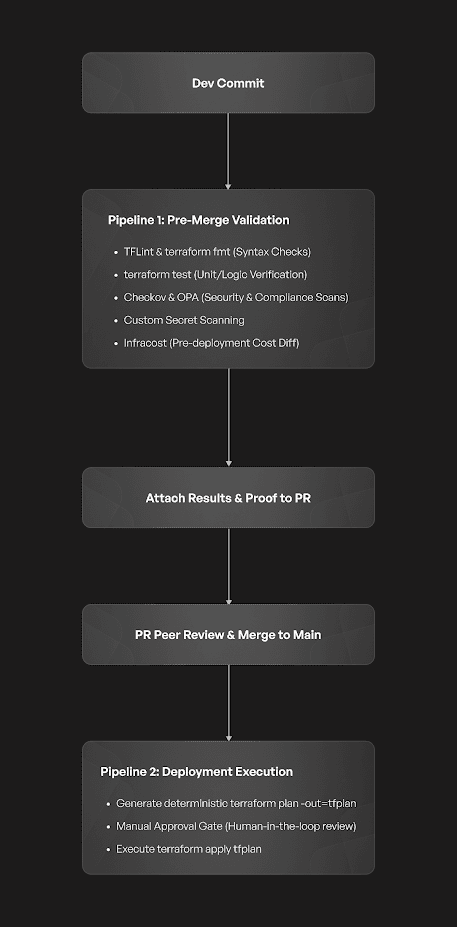
Pipeline 1: Automated Pre-Merge Validation
Triggered automatically on every commit to a feature branch or Pull Request, this pipeline acts as an automated gatekeeper before code touches the primary deployment branch:
- Linting & Syntax Formatting: Runs
tflintandterraform fmt -checkto eliminate syntax errors, unused variables, and formatting inconsistencies. - Unit & Logic Verification: Runs
terraform testto validate module inputs, outputs, and conditional logical paths against mock data. - Shift-Left Security Analysis: Runs Checkov against static code to flag misconfigurations—such as unencrypted EBS volumes, overly permissive security group rules (0.0.0.0/0), or missing logging configurations.
- Policy as Code (PaC): Applies Open Policy Agent (OPA) or AWS CloudFormation Guard rules to enforce organizational standards (for example, "All S3 buckets must enforce KMS encryption and block public access").
- Secret Detection: Scans code for hardcoded API tokens, database passwords, or AWS access keys.
- Pre-Deployment Cost Forecasting: Runs
Infracostto calculate exact financial diffs, posting expected cost increases or decreases directly as a comment on the Pull Request. - Speculative Plan Output: Generates a speculative
terraform planand posts the execution summary to the PR for peer review.
Pipeline 2: Deterministic Deployment Execution
Triggered following a successful PR merge into the main branch (or via an explicit manual trigger):
- Deterministic Plan File Generation: The pipeline runs
terraform plan -out=tfplan. This creates an immutable, saved execution plan artifact. - Human-in-the-Loop Approval Gate: Execution pauses. A designated DevOps Lead or Technical Architect reviews the saved
tfplanoutput in the CI/CD interface and explicitly grants approval. - Strict Artifact Execution: Upon approval, the pipeline executes
terraform apply tfplan. Applying the saved plan file guarantees that what was reviewed and approved is exactly what gets provisioned in AWS, with zero possibility of code changing between the review step and the apply step.
Catching Drift and Enforcing Policy in Day 2 Operations
Setting up automated pipelines for the initial deployment is only half the battle. Day-2 operations—managing continuous drift and maintaining security posture over time—are where incomplete GitOps usually falls apart.
Human intervention during emergencies is an inevitable reality of operations. When a Sev-1 outage hits at 2:00 AM, engineers will log into the console to fix things. But if those console edits aren't reconciled immediately, they become permanent security holes and untracked cloud spend.
To enforce the rule that Git is the true single source of truth, organizations must implement two continuous automated loops:
Automated Daily Drift Detection
- Every night, scheduled CI/CD pipeline jobs should execute a
terraform planin non-refresh mode across all AWS accounts. - If the live AWS infrastructure differs from the codified baseline in the main branch, the pipeline flags the configuration drift and immediately fires an alert to the platform team via Slack, Teams, or PagerDuty.
- The team is then forced to acknowledge the change: they must either reconcile the drift by importing the manual change into code via a Pull Request or execute an automated pipeline apply to overwrite the unauthorized console change.
Continuous Policy as Code (PaC) Enforcement
While pre-merge tools like Checkov catch bad code before it is deployed, you also need tools to catch bad human behavior that bypasses the pipeline entirely. By running continuous Policy as Code tools—such as Cloud Custodian or PacBot—you actively audit the live AWS environment against your organization's security and compliance rules.
If an engineer manually opens port 22 to the public internet during a late-night troubleshooting session, or accidentally makes an S3 bucket public, the PaC tool instantly detects the violation. Depending on the severity, these tools can either alert the security team or trigger automated remediations (like instantly terminating the non-compliant resource).
Principles for Resilient Cloud Operations
Moving from GitOps in name only to a battle-tested, audit-ready delivery framework requires engineering discipline directly into the deployment systems. Whether you are designing a new landing zone from scratch or untangling years of legacy infrastructure, here are four strategic principles to build into your environments:
- Architect for Isolation: Stop dumping core networking, shared clusters, and microservice databases into single repositories. Adopt a tiered, bottom-up architecture to keep blast radiuses small. If a deployment fails, it should only break the specific service being updated.
- Make Security a Prerequisite: Running security tools after infrastructure is live is too late. Embed tools like Checkov, OPA, and Infracost directly into pre-merge pipelines so security defects and cost spikes are caught before code ever touches production.
- Design for Automation, Plan for Reality: Ideally, every infrastructure change should flow through the CI/CD pipeline using deterministic plan artifacts and automated approval gates. However, emergency manual interventions are an operational reality. The goal is to implement automated drift detection that immediately flags out-of-band edits so they can be reconciled back into version control before they become permanent risks.
- Codify the Perimeter: Treat Identity and Access Management (IAM) as a core part of the infrastructure lifecycle. Manage IAM policies and Identity Center permission sets through the same IaC pipelines as compute resources, and eliminate static access keys in favor of passwordless, role-backed CI/CD runners.
Don't wait for the next 2:00 AM outage to test your GitOps maturity. Connect with our Cloud engineering team to build a resilient 4-layered IaC architecture.