


For over two decades, digital advertising has evolved along a predictable path, from search queries to social feeds to programmatic automation. Predictable because, as marketers, we could map that journey, influence it at different touchpoints, and optimize it with reasonable clarity. All that is behind us now, and a new reality is taking shape.
Recent data suggest that for more than 30% of consumers, the search process begins on AI interfaces rather than on Google. Even within traditional search engines, AI-generated answers are diverting users before they click a link.
This means the traditional marketing funnel is no longer operating the way marketers are used to.
What’s in this article:
- How changes in the search landscape are redefining digital advertising
- Why AI platforms could become the next major advertising ecosystem after search and social
- What the rise of agentic commerce means for brands, retailers, and customer journeys
From ‘Discovery’ to Decision-Support
For years, the internet has been organized around search. Keywords acted as clean signals of intent, and entire industries, from SEO to programmatic, were built around interpreting and acting on those signals.
But intent has always been more nuanced than a keyword. People don’t think in isolated search terms; they think in context, preferences, and outcomes. AI platforms are now able to interpret those layers in a way traditional search engines never could.
A query like “best CRM tools” once led to competing ads and SEO-optimized blogs. Today, a more natural input like “What’s a good CRM for a small SaaS team that integrates with HubSpot and isn’t too expensive?” results in a clear recommendation. That’s no longer a discovery. It is decision support in real time. Once decisions begin forming inside the interface itself, the traditional points of influence—the websites, the ads, and the intermediaries—lose their leverage.
Entry of Ads in the Conversational AI Ecosystem
The industry is currently pivoting from experimental GenAI to a commercialized one, through advertising, commerce, and AI-driven recommendations, in what is seen as the “Google moment” for generative AI platforms. And as platforms like OpenAI and Perplexity explore monetization models, we are beginning to see the early contours of Answer Engine Optimization (AEO), a hybrid of SEO, paid media, and contextual intelligence.
Because users are now guided toward specific decisions rather than being left to explore a list of links, the fundamental units of advertising inventory have changed:
Targeting is based on semantic intent, not cookies
Instead of targeting users based on websites they visited days ago, brands can align with the actual context of a live conversation. For example, if a user asks for “easy meal ideas for diabetics,” a health food brand or nutrition app could become part of that recommendation journey.
Placements are embedded within answers, not pages
While ads appear around the content in traditional digital advertising, in AI environments, the recommendation itself may become the placement. A travel insurance provider, for instance, could be surfaced directly within a conversation about planning an international trip.
Optimization relies on interaction signals, not just clicks
Success no longer depends only on clicks or impressions, but on how users engage with AI-generated recommendations. If users repeatedly ask follow-up questions about a suggested product or service, that interaction itself becomes a stronger performance signal.
This is where AEO becomes critical, not just as an organic strategy, but as a paid media discipline.
The Rise of Agentic Commerce
Alongside this shift is the rapid rise of agentic workflows. These systems can now discover options, compare alternatives, recommend choices, and even initiate transactions.
Frameworks like Agent Commerce Protocol (ACP) are accelerating this trend, and industry data suggests a sharp rise in AI-assisted shopping interactions. The appeal is obvious: fewer steps, faster outcomes, reduced friction.
While still early, the agentic commerce market is projected to grow rapidly—from under $10 billion today to over $60 billion by the early 2030s—with broader AI-influenced commerce expected to reach hundreds of billions in value.
Nearly 40% of U.S. consumers now use AI during shopping journeys, and AI-driven interactions are expected to influence more than $262 billion in global e-commerce sales during the holiday season, according to Salesforce research. Across markets, users are increasingly turning to AI not just for discovery, but for product research, comparison, and decision support.
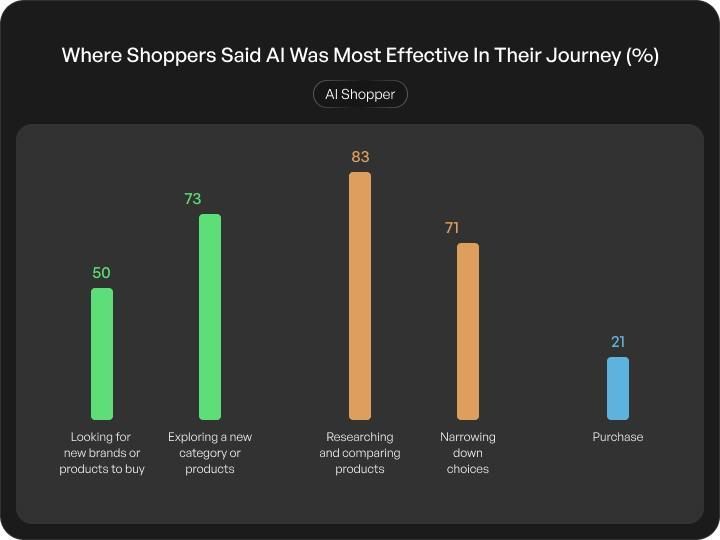
Shoppers found the most value using AI for product research and comparison.
Source: IAB/Talk Shoppe AI Commerce Study, 2025
But despite this rapid adoption, consumer behavior still reveals an important boundary. Users are comfortable asking AI for recommendations. They are less comfortable letting it complete the purchase without involvement. The act of choosing—of comparing, validating, and committing—still matters. This creates a tension between automation and control.
Why Retailers Won’t Yield the Last Mile
If AI platforms own the discovery phase, they effectively become the new storefront. For brands, this represents a strategic crisis: the potential loss of data ownership, attribution, and the customer experience.
This has led companies like Walmart and Shopify to rethink how they integrate with AI ecosystems. Walmart is embedding its own shopping assistant, Sparky, into AI environments rather than outsourcing it to third-party agents.
Similarly, Shopify is upgrading Sidekick to agentic storefronts globally, allowing merchants to transact within AI-driven conversations while retaining control of their commerce infrastructure. This reflects a broader industry stance: Brands want AI to assist discovery, not own the transaction.
In Europe, the pace is more measured. Regulatory frameworks such as GDPR and a stronger emphasis on consumer data protection mean adoption is happening with tighter guardrails. Retailers are exploring AI-assisted discovery, but with greater caution around automation in transactions and data sharing.
In short, brands want to own the outcome even if AI engines own the journey.
A Structural Shift, Not Just a Technological One
Taken together, these developments point to a structural shift in how digital ecosystems operate.
AI is becoming the interface where:
- Intent is expressed
- Options are filtered
- Decisions are shaped
At the same time, brands and retailers are redefining how much of that journey they are willing to delegate. For marketers, this means the boundaries of the funnel are beginning to blur. Discovery is no longer separate from decision-making, and programmatic is no longer limited to predefined inventory.
In Part 2, we explore what the shift means for programmatic advertising, how governance and data come into play, and how marketing teams can start preparing for a world where the “inventory” is no longer a page, but a conversation.