


Moving data is rarely the hardest part of a modern data platform. The hard part is moving it within a business service-level agreement (SLA), preserving data correctness through system failures, and keeping infrastructure costs from rising as you add new data sources and consumers.
When pipelines break, traditional platforms rely on global restarts or manual backfills. Efficient scaling requires a self-healing architecture: a platform designed to isolate failure boundaries, track granular state, and recover individual tables automatically without human intervention or redundant compute.
What's in this article:
- How we combined CDC, Kafka, and Delta Lake to reduce latency while keeping merge compute overhead minimal
- Data skipping and access techniques (Z-ordering, partition pruning, disk caching) that reduce Spark runtime by 65%
- How target-derived watermarking insulates ingestion pipelines from unequal source API delays
- Fault-Tolerant Orchestration to eliminate false-success reads and avoid compounding retry loops in production
Scalable Architecture Principles for Complex Workloads
Two of our large-scale Databricks implementations demonstrate this shift toward self-healing data architectures.
The first implementation, for an IoT analytics platform, required a lakehouse capable of processing continuous satellite-connectivity updates in near-real time while supporting resource-intensive Spark reporting. The second, for a medical diagnostics firm, required replacing a rigid, global lookback model across a 200+ source API estate with independent, table-level recovery paths.
While their operational domains differed, both organizations faced the same underlying issue: legacy pipeline patterns that grew more fragile and expensive as data volume expanded. Solving it required moving away from blind appends and broad lookback windows to engineering platforms that recover independently, scale deterministically, and operate cost-effectively.
Case Study 1: Balancing Low-Latency CDC with High-Volume Reporting
The IoT analytics platform monitors satellite-connectivity operations across high volumes of active subscribers. Operational state changes trigger automated downstream alerting, which makes daily batch processing unfeasible. Concurrently, the same platform runs daily Spark reporting workloads.
This environment created two competing technical requirements:
- Connectivity changes had to reach the analytical platform in under a minute.
- Spark reporting workloads had to process growing historical data without repeatedly scanning and shuffling unnecessary data.
Increasing cluster size could make an individual job faster, but it would not solve inefficient data access or make replay safe. The platform needed an architecture that handled freshness, correctness, performance, and deployment as one production system.
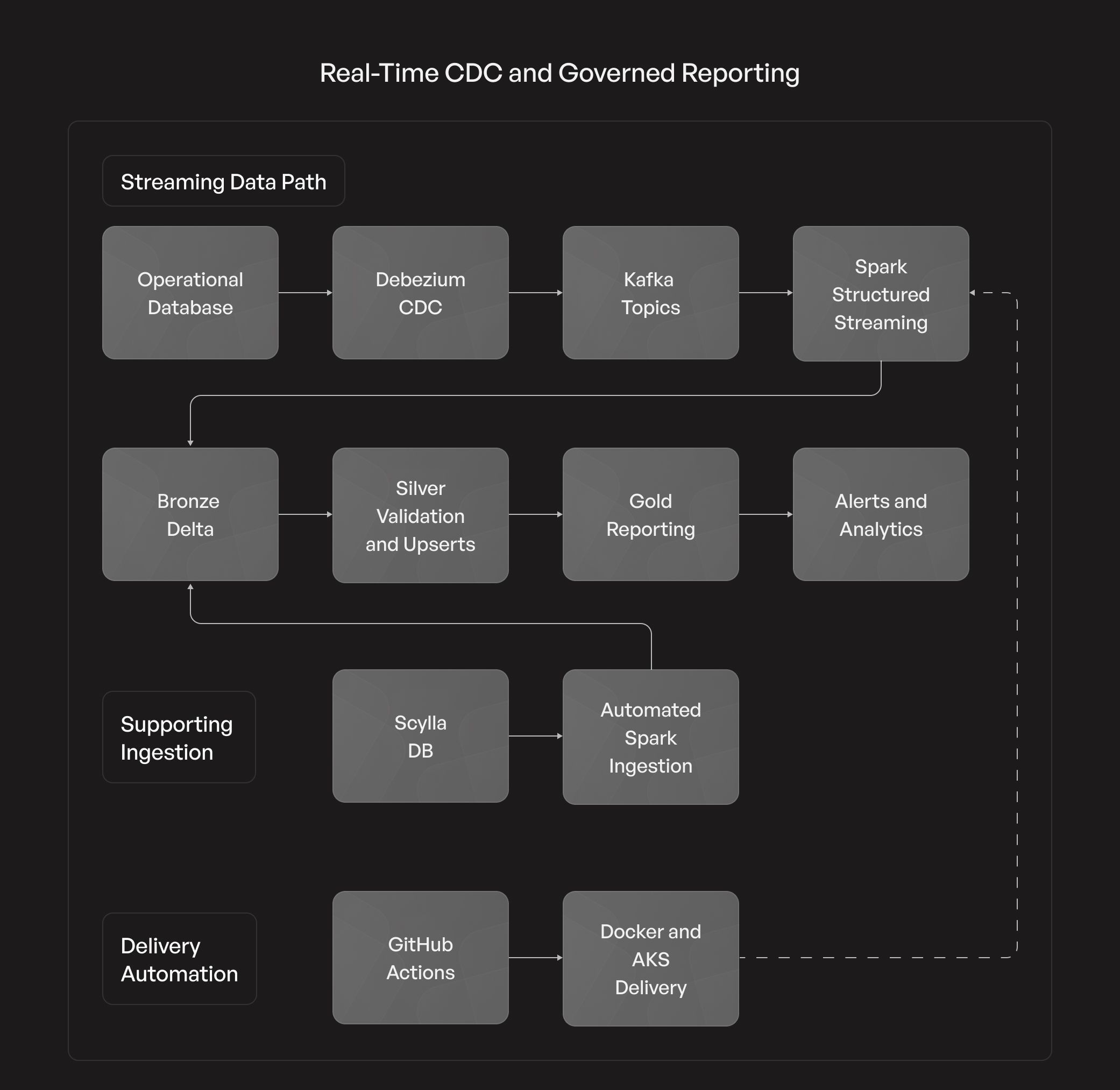
Debezium extracts transaction log changes from operational databases—including high-throughput ScyllaDB stores—and streams them to Kafka topics. Spark Structured Streaming consumes these events and writes raw audit logs directly to Delta Bronze tables. Silver processing validates inputs, removes duplicates, and executes upserts, preparing Gold tables for reporting consumption.
Overcoming Bottlenecks in Streaming and Query Performance
Idempotent Upserts Over Blind Appends
A restarted streaming job can replay a micro-batch. Events can also arrive later than expected. Checkpointing protects the stream's source progress, but the target operation must still be repeatable. Otherwise, a technically successful recovery can create duplicate records or apply stale state. The target write was therefore treated as an idempotent upsert rather than a blind append. This allowed a replayed change to be reconciled against the existing Delta record.
Targeted Delta Merges
Shorter micro-batches improve freshness, but every batch carries scheduling and Delta MERGE overhead. If the merge condition searches the full target table, a low-latency design becomes increasingly expensive as history grows. The trigger interval was tuned around the actual freshness requirement, and merge conditions were kept selective so that each batch touched the smallest practical target area.
Physical Layout Optimization
The bottleneck in reporting workloads was object storage I/O, not raw CPU capacity. Aligning partition layout with date filters enabled aggressive partition pruning. Z-ordering high-cardinality join keys improved file-skipping performance, and Databricks local disk caching eliminated repeated storage fetches.
Measured Impact
The resulting CDC path delivered changes to Delta Lake with sub-60-second end-to-end latency for the target workload. The Spark optimization work reduced the affected reporting runtime by approximately 65% and returned the job to its required processing window.
The important result was not simply a faster Spark job. The platform supported near-real-time and scheduled workloads through the same governed Delta foundation, while reducing the amount of data read and processed for each report.
Case Study 2: Replacing Global Recovery with Table-level State for Diagnostics Firm
An enterprise molecular diagnostics platform’s Databricks environment contained a shared ingestion framework serving many data domains. One API-based ingestion configuration alone described more than 200 source objects, each mapped to its own Delta target and key definition.
The earlier scheduling pattern applied the same fixed lookback window to every object. That works only when every source table advances consistently. In production, a delay or failure in a single upstream API forced engineers into an inefficient choice: execute a narrow lookback (the time range queried to fetch newly added or modified records) and risk dropping late-arriving patient data, or widen the lookback window across all 200+ tables, reprocessing vast amounts of unchanged historical data. The problem was therefore both a data-correctness risk and a recurring API and compute-cost issue.
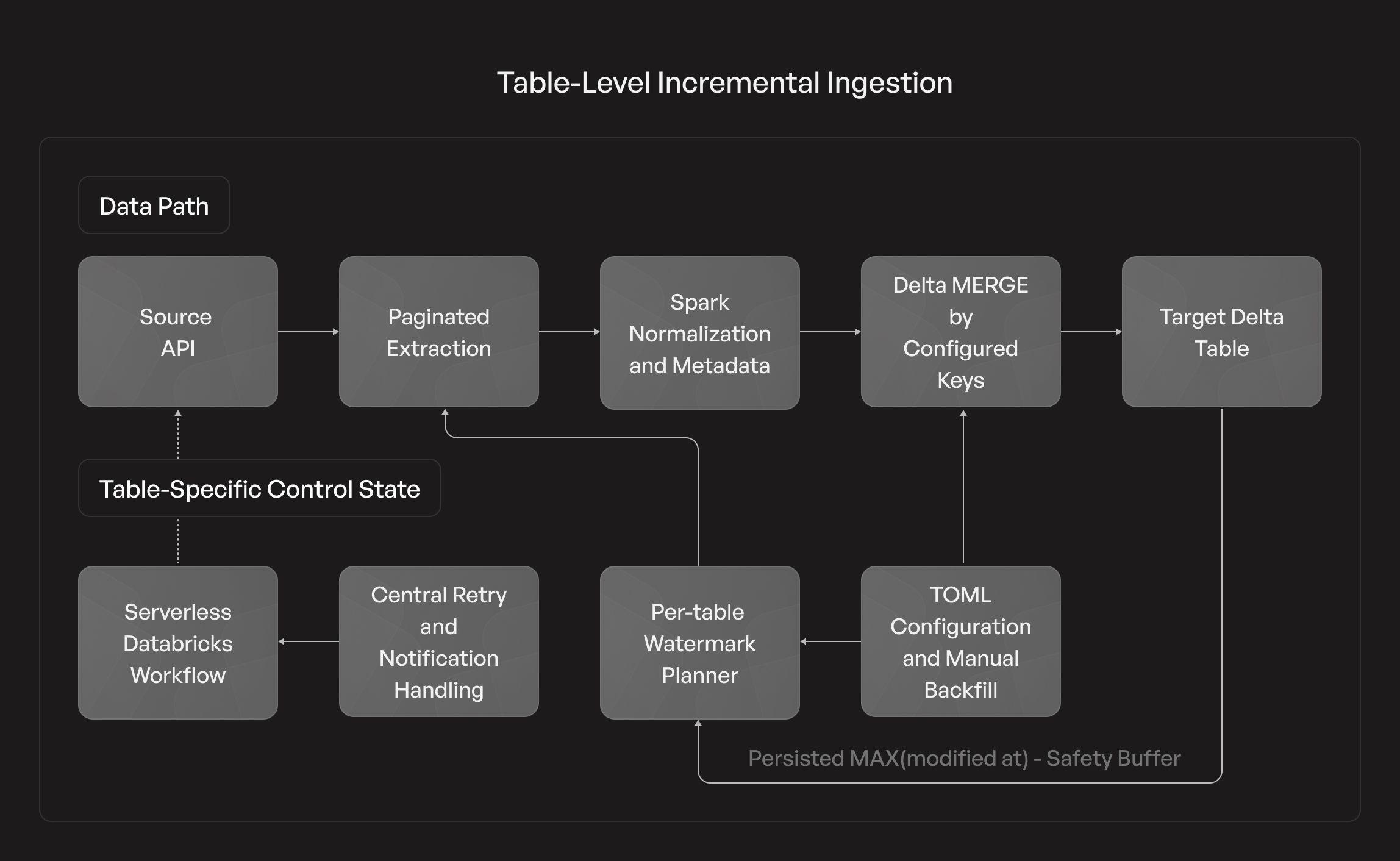
The key architectural change was to shift state tracking to the individual table level. Instead of querying a global calendar time range for all sources, each pipeline reads the last updated timestamp recorded in its specific target Delta table to determine exactly where to resume extraction.
For an existing Delta table, the job reads the maximum value of the configured source-modification field. It subtracts a configurable safety buffer and uses the result as that table's next extraction date. The small overlap protects records close to the time boundary. Delta MERGE, using the configured primary keys, reconciles overlapping records instead of appending duplicates.
If the table is new or contains no watermark, the pipeline uses a configurable fallback window. A manually supplied start date takes precedence when an engineer needs to run a controlled backfill.
The watermark only advances when data is successfully persisted in the Delta target. This gives tables an independent recovery path:
- Healthy tables continue from their latest stored position.
- Delayed tables retain their older position and request the missing period on the next run.
- New or empty tables start from the configured fallback.
- A historical correction uses the supported backfill parameter instead of a temporary code change.
The state needed for recovery already exists in Delta Lake; the pipeline does not require a separate global success date that can drift away from the actual target data.
Expected first-load conditions and unexpected platform failures must remain distinct. A missing or empty table can use the fallback window. Schema, permission, or upstream network failures raise explicit exceptions without corrupting state or falsely signaling successful runs.
Eliminating Silent Failures and Redundant Retries
API-ingestion pipelines require clear distinctions between an empty response payload, a transient failure, and a fatal exception.
To streamline production operations, HTTP error responses were updated to throw explicit system exceptions rather than returning empty payloads. Application retries were strictly capped, terminal logging was restricted to final failures, and redundant Databricks workflow-level task retries were removed to avoid compounding execution loops. Finally, compute profiles were transitioned to Databricks Serverless Standard mode to eliminate idle cluster startup overhead for batch tasks.
Time and Cost Impact
The improvement does not depend on an assumed savings percentage. Its cost mechanism is direct:
- Narrow Extraction Windows: Each table extracts only its required change window, preventing 200+ healthy sources from repeating long lookbacks when a single upstream API lags.
- Controlled Overlap Reconciliations: The safety overlap is deliberately small and reconciled through Delta merge, avoiding double-processing.
- Zero Silent Failures: Failed API calls cannot silently produce incomplete "successful" loads, stopping corrupt downstream runs before they consume compute.
- Consolidated Retry Logic: Restricting retry management to a single layer eliminates duplicated API traffic, compute attempts, and alert noise.
- Serverless Cost Alignment: Databricks Serverless Standard mode aligns the compute profile with a scheduled batch workload, stripping idle cluster overhead.
API volume, processed-row counts, job duration, retry frequency, and Databricks usage records provide a clear basis for measuring the resulting benefit.
The Larger Lesson on Engineering Enterprise Data Platforms
Scaling an enterprise lakehouse beyond its initial setup requires moving past basic deployment templates. The true value of an enterprise data platform lies in how cleanly it operates under failure conditions, how predictably it recovers, and whether its cost structure scales strictly with useful analytical output rather than operational overhead.
Delivering that level of platform maturity requires deep engineering across five core competencies:
- Real-Time CDC Architectures: Deploying low-latency streaming paths using Kafka, Spark Structured Streaming, and Delta Lake to support strict operational SLAs.
- Reusable Ingestion Frameworks: Designing batch ingestion systems that handle large, uneven API and source estates without duplicating lookback effort.
- Storage and Compute Performance Engineering: Resolving physical Spark bottlenecks through targeted partition pruning, Z-ordering, selective merges, and local caching.
- Resilient Recovery Patterns: Implementing target-derived watermarks, explicit checkpoints, idempotent writes, and isolated backfill controls directly into the data path.
- Cost-Aware Orchestration: Configuring workflows, monitoring, alerting, and compute modes (such as serverless) to align infrastructure costs with actual processing work.
Building reliable data products means selecting the precise ingestion, storage, processing, and recovery patterns required for each business SLA. Combining lakehouse architecture with rigorous production engineering transforms reactive pipelines into self-healing enterprise assets—delivering timely data, predictable recovery, and measurable performance at scale.
Looking to optimize your data infrastructure or build resilient lakehouse architectures? By combining deep Databricks architectural expertise with rigorous production engineering —from state management to cost-aware orchestration—we help organizations transform reactive data pipelines into reliable, self-healing data products.