
-1778149456690.jpg)

The textbook definition of Platform Engineering goes something like this:
"Platform engineering is the discipline of designing and building toolchains and workflows that enable self-service capabilities for software engineering organizations in the cloud-native era."
But what does it actually mean?
What’s in this article:
- What is Platform Engineering?
- Why is the shift from DevOps to Platform Engineering necessary?
- Do you actually need an Internal Developer Platform (IDP) to succeed?
- When do you need to actually invest in a formal IDP?
- How does Platform Engineering change the role of the Ops engineer?
Platform engineering really just means acknowledging that the modern cloud-native stack (Kubernetes, Terraform, CI/CD, security policies) is too complex for standard developers to master while focusing on business logic.
It means you stop paying DevOps engineers just to sit around and trigger deployments. Instead, you have them create automations for all their daily, repetitive tasks. The end goal is turning those automations into self-service capabilities that developers can trigger themselves.
From that point onward, the Platform Engineer (the former DevOps engineer) is responsible for maintaining this platform. They become an automation expert who gives power back to the developers while enforcing the necessary standards across the project.
Sounds great. But how do you get there?
Many engineering teams fall into the trap of thinking they need an Internal Developer Platform (IDP), a shiny UI where developers click buttons to deploy code. You could buy this as a SaaS, or you could build it out yourself, piece by piece, tuned exactly to how your team works. You could build the IDP to connect to your existing tools (GitHub, Octopus, ArgoCD) and wrap your existing logic.
Your Curated Stack IS Your Platform
While an IDP is one way to implement platform engineering, you don’t actually need it. In fact, if you already have a highly mature DevOps team, you are probably already doing Platform Engineering.
Let me give you a real-world example of what this looks like without a dedicated IDP. I work for a client where we already have a standardized GitHub strategy. We have documented almost every single part of our infrastructure in Confluence. We use Jenkins for CI, Terraform, and GitOps to apply infrastructure changes, and ArgoCD to deploy the end applications. We have a robust set of shared libraries in Jenkins to trigger all jobs.
Because of this stack:
- A new environment can be built in a matter of days.
- Pipelines can be updated to enforce a new security scan via shared libraries in hours.
- Multiple self-service jobs are open to developers so they can trigger and apply changes themselves.
- New developers can push their first feature to staging from day one, without ever needing to touch the infra.
- If someone alters something, ArgoCD immediately detects it as configuration drift, allowing us to sync it back to the original.
We don’t have a fancy UI, and we don’t have a formal IDP, but this is our platform. We are already providing golden paths via code rather than a GUI.
So the transition from traditional DevOps to Platform Engineering isn't about buying new software. It is a shift in your operating model. It means treating your backend ops tools as a cohesive product, and treating your developers as customers. If your curated stack is highly automated, thoroughly documented, and allows developers to push to production with minimal friction and zero manual ops tickets, you have already achieved the primary goal of Platform Engineering.
When Do You Need an IDP?
When should you actually invest in an Internal Developer Platform? An IDP becomes the next logical step when the sheer number of microservices and disparate teams causes your custom automation approach to break down.
It could be an expensive, vendor-provided enterprise tool, or it could simply be an internal wrapper tool that connects all your existing tools via API plugins. Either way, when implemented correctly, a true IDP solves very specific scaling problems:
- Service Catalog: In a multi-team environment, cross-team communication is a massive bottleneck. The IDP acts as a universal directory. If a developer needs to consume an internal API, they don't ask around on Slack. They check the catalog to find the service, its API specs, deployment status, and on-call owner.
- Day 0 Scaffolding: Starting a new project shouldn't take two weeks. The IDP provides templated, approved scaffolding. A developer clicks a few buttons, and the IDP automatically provisions the repo, baseline CI/CD pipeline, cloud IAM roles, monitoring tools, and initial infrastructure.
- Golden Paths: Instead of dictating exactly how a developer must write their code, the IDP provides a paved road. If developers stay on the golden path (using approved CI tools and standard configurations), they get automated security, compliance, and deployment.
- Day 2 Implementations and Centralized Updates: This is where IDPs prove their worth to the Ops team. If a new security vulnerability requires a scanner in every pipeline, Ops can update the central Golden Path once (instead of manually updating 100 different repositories). The enforcement then cascades automatically to every connected application.
- The Single Pane of Glass: Developers don’t have to open ten browser tabs to understand their application's health. The IDP uses plugins to aggregate CI/CD status, infrastructure health, security vulnerabilities, and application logs into one centralized developer dashboard.
- Cost Visibility (FinOps): Standard DevOps hides the cloud bill from the people writing the code. A mature IDP pulls data from your cloud provider and displays the cost of each microservice on the developer's dashboard. When developers see the actual price tag of their architectural choices, they naturally optimize their code without retroactive interventions from Operations.
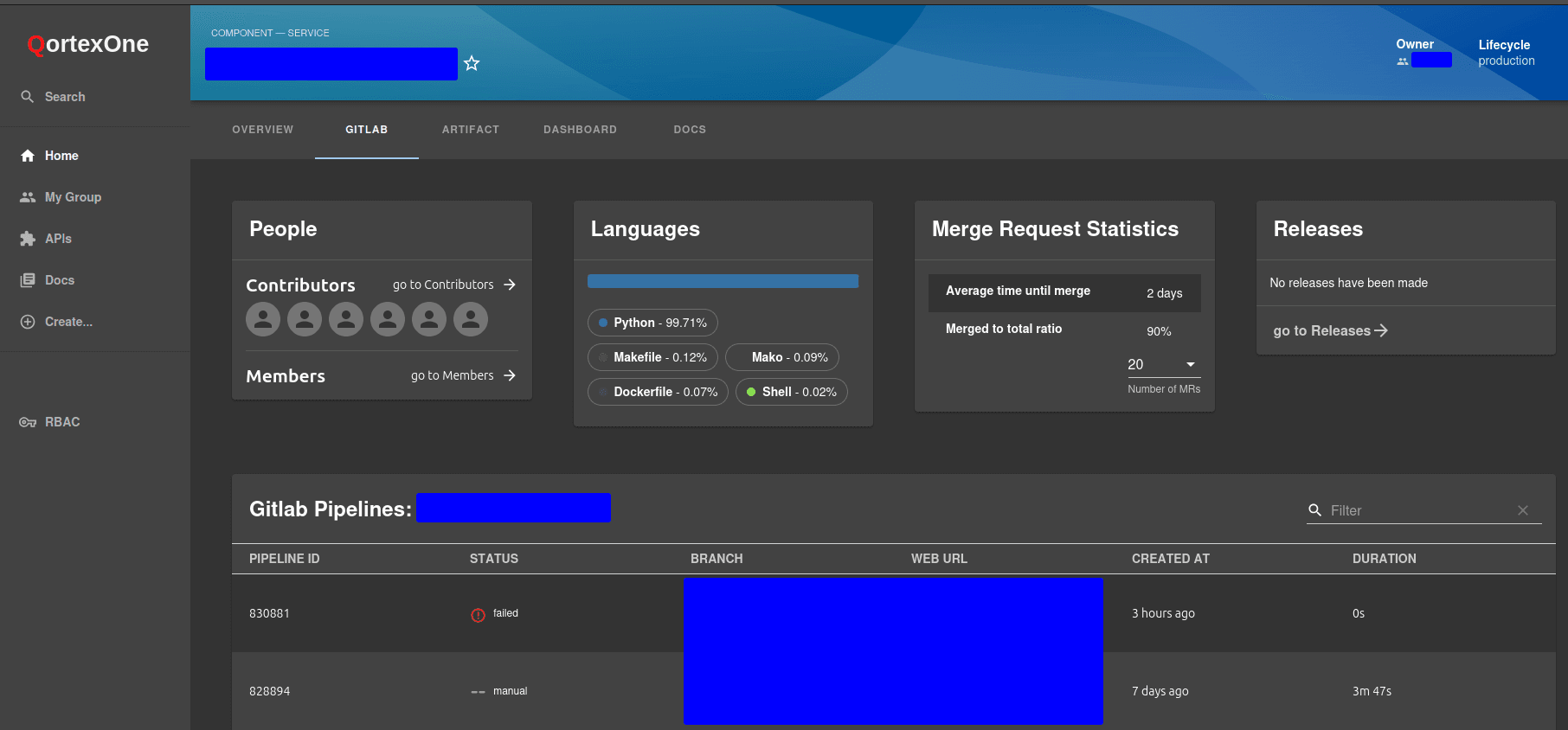
At QBurst, we have created our own internal IDP called QortexOne. Using QortexOne, we rely heavily on Golden Paths to offer developers rapid project onboarding. It gives them the self-service speed they want, while giving Ops the guarantee that every single deployment is standardized and strictly aligned with our established cloud best practices.
Why Platform Engineering Is the Future of DevOps
For a long time, DevOps has really meant a modern cloud engineer/sysadmin: an infrastructure expert who embeds development practices and code into their toolkit. But as cloud environments scale exponentially, having those highly skilled experts manually trigger deployments, configure environments, or maintain a massive web of individual scripts just creates a new kind of bottleneck.
Platform Engineering is the natural evolution of that role. Instead of just automating your own operational tasks, you package those automations into a self-service product. You stop being the person who runs the infrastructure for the developers, and you become the engineer who builds the secure, automated road they drive on.
Even if you never build a centralized UI, adopting this mindset is critical. Stop fulfilling tickets and start building self-service capabilities. Centralize your policies, automate your Day 2 operations, and curate your stack. You don't need a fancy portal to do that; only the right approach. Whether accessed via an expensive web UI, a simple CLI, or a standardized set of GitOps repositories, a well-engineered platform is the only way to scale a modern software organization without scaling your Ops headcount right alongside it.