
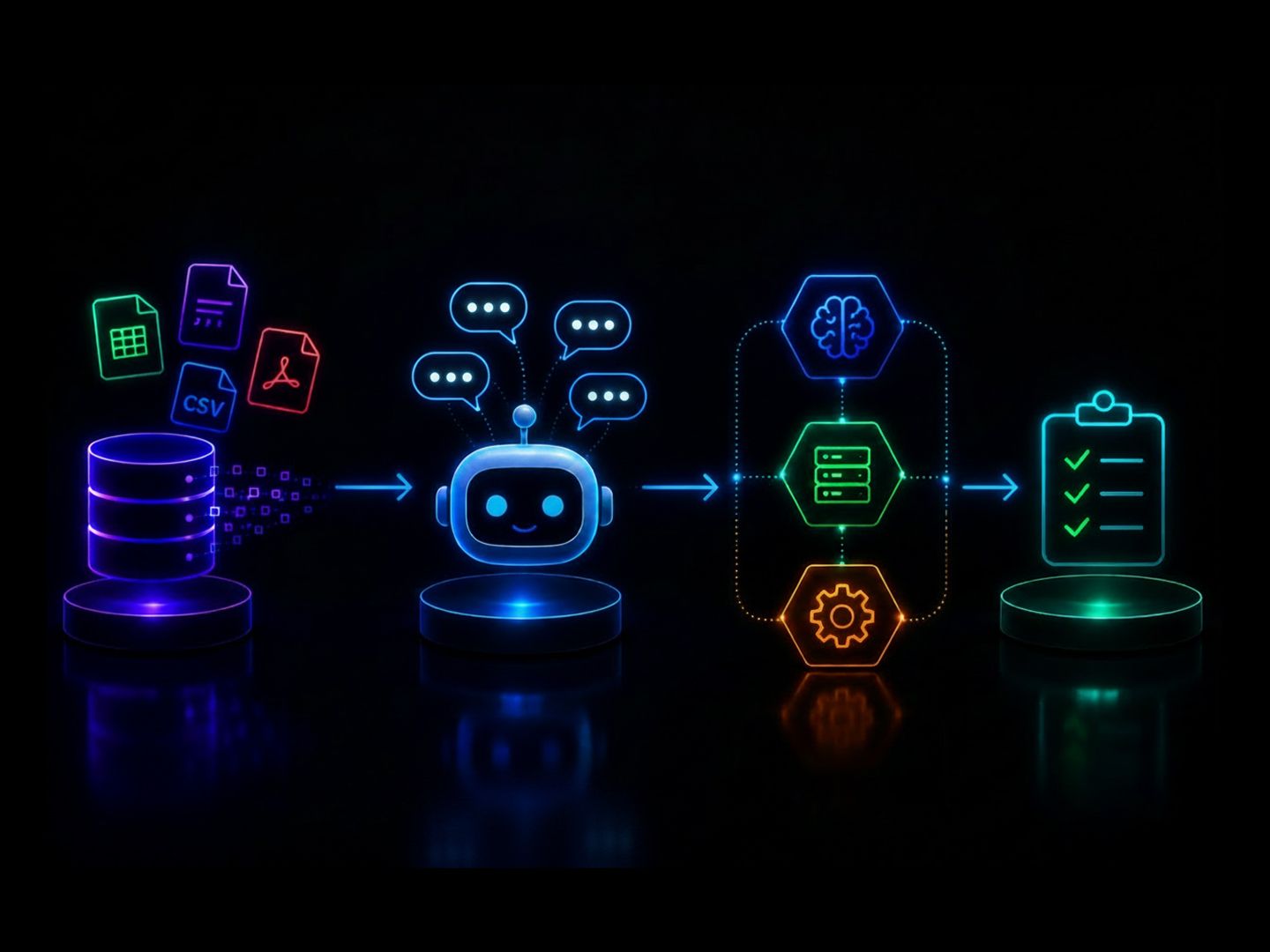

In a previous article, I shared how our AI-powered multilingual talent acquisition platform evolved from a prototype to a live enterprise system. This required solving three technical challenges along the way: messy enterprise data, unpredictable LLM behavior, and shared infrastructure limits. This article breaks down these challenges and the architectural patterns we used to solve them.
What's in this article:
- Handling unpredictable LLM responses with defensive data pipelines
- Using reference data to bridge the gap in enterprise context
- Validating cloud AI quotas under sustained load
- Preventing mixed database workloads from competing for shared resources
1. Managing Unpredictable LLM Outputs
Even with engineered prompts and explicit schemas, the LLM we used to extract structured data from candidate profiles, job descriptions, and interpret natural-language search queries occasionally produced errors. It would return malformed JSON unparseable by downstream services, generate values outside approved reference data, and produce outputs that violated business rules, despite having the correct syntax.
To reduce these risks, we treated the enterprise context as part of the AI architecture. Since we couldn't prevent every failure, our objective was to detect, contain, and recover from them before they affected users.
We implemented a defensive AI pipeline that validated every interaction stage:
| Stage | Purpose | Why It's Necessary |
| Preprocessing | Clean, normalize, and enrich input using enterprise reference data (stored in PostgreSQL/OpenSearch). | Improves input quality and reduces errors caused by incomplete data. |
| Prompt Construction | Build structured, version-controlled prompts in the DB with a clear business context. | Increases consistency and allows instruction updates without deployments. |
| Response Validation | Verify AI responses against schemas and controlled business vocabularies. | Prevents invalid or non-compliant data from entering downstream systems. |
| Retry Logic | Retry transient failures using configurable backoff and resilience policies. | Automatically recovers from temporary AI service failures. |
| Fallback Strategy | Configurable parsing strategies (for example, switching between Amazon Bedrock and Textkernel). | Maintains business continuity and extraction accuracy during service disruptions. |
Since Amazon Bedrock did not provide structured output capabilities at the time of this implementation, the application had to validate every response. Structured outputs are now available in Amazon Bedrock, which can reduce the need for custom validation logic in newer projects.
Key Takeaway
Validation reduces risk but does not remove uncertainty; even low failure rates are significant at scale. Therefore, never assume LLM output is correct just because it is well-formed. Always treat responses as untrusted input and validate them against enterprise context and business rules before they hit the rest of the application.
2. Handling Hidden Infrastructure Constraints
Amazon Bedrock publishes its rate and token limits, but understanding how they affect a specific application requires testing under realistic conditions. During development, the platform stayed well within those boundaries. Under continuous load, the application began encountering timeout exceptions and HTTP 429 ("Too Many Requests") responses as it reached the service's documented throughput limits.
To prevent these limits from stalling the platform, we built capacity management directly into the architecture:
- Quota-Mapping: Throughput limits vary by model and region, so we mapped Bedrock's request and token quotas early and used them as input to capacity planning.
- Sustained Load Validation: We extended our load testing to simulate prolonged demand, ensuring the system could sustain real-world global traffic.
- Throttling as a Runtime Condition: Rather than assuming unlimited availability, we built retry policies with exponential backoff and graceful degradation directly into the service integration layer. This ensured the application remained responsive even when Bedrock returned timeouts or HTTP 429 responses.
Key Takeaway
Successful enterprise AI depends heavily on infrastructure planning. Validate capacity limits during architecture and load testing, treat AI services as finite infrastructure, and design applications to operate predictably when limits are reached.
3. Database Pressure from Competing Workloads
The third challenge emerged in the data layer: our platform combined transactional operations, semantic search, location-based retrieval, and real-time analytical queries within a single user journey. While each performed well independently, running them together under production load created severe resource pressure.
Complex queries and vector searches competed with transactional operations for the same CPU, I/O, and connection pool resources. Long-running queries held connections, concurrency saturated the pool, and database slowdowns triggered retry logic including @Retryable flows that re-invoked Bedrock calls, creating a feedback loop that amplified the original pressure.
A subtler issue involved parallel execution and transaction boundaries. Because Spring binds transaction context to the thread, requests that started inside a @Transactional flow and delegated work to worker threads caused each thread to acquire its own connection. As a result, a single user request could exhaust the pool much faster than standard request counts suggested.
To stabilize the system and reduce the pressure, we made three key design decisions:
- Offloading to OpenSearch: Vector similarity searches, complex count queries, and aggregation workloads were moved out of PostgreSQL and into OpenSearch, which is purpose-built for these retrieval-heavy patterns. This was the single most impactful change; it freed the PostgreSQL connection pool from long-running search operations and dramatically reduced response times for transactional workflows.
- Isolated Transactional and Search Workloads: Enterprise AI naturally combines transactional processing, retrieval, and analytics into a single business workflow. By treating each as an independent workload with its own resource path, PostgreSQL could focus on ACID-compliant operations without competing against expensive search and analytics queries.
- Batched and Precomputed Heavy Work Asynchronously: Large match jobs and data-processing flows were broken into smaller, configurable batches and run in controlled parallel steps during off-peak windows. Results were preprocessed and stored ahead of time, so peak API traffic could read persisted results instead of hammering the database on demand. This meant fewer timeouts and far less competition for database connections when users needed them most.
Key Takeaway
The exact technology choices will vary across organizations. Still, the broader principle remains the same: enterprise AI changes database usage patterns by converging transactional, retrieval, and analytical workloads within a single application flow. Rather than relying on larger databases alone, the solution lies in designing explicit boundaries between these workload types. Separating their responsibilities prevents resource pressure from becoming a system-wide bottleneck.
Engineering AI for the Real World
Enterprise AI initiatives succeed or fail on the strength of their underlying infrastructure. While sophisticated models may drive the core capabilities, scaling a global HR platform requires actively managing the realities of connection pools, API rate limits, and concurrent database workloads.
Securing long-term value from these platforms demands an architecture designed specifically for resource isolation and capacity management. Establishing this resilient foundation allows the system to operate reliably under enterprise-level pressure today, while providing the stability needed to integrate future innovations tomorrow.