


GenAI is no longer an experiment in a single innovation lab. Network telemetry shows enterprise GenAI traffic surged nearly 900% in 2024. Organizations are interacting with dozens of unsanctioned GenAI apps, causing data loss incidents linked to AI to double. Today, they make up 14% of all SaaS Data Loss Prevention (DLP) events.
Behind these numbers is a familiar pattern: when vetted AI tools are slowed by pay-per-token budgets or compliance controls that affect output quality, employees turn to personal subscriptions that offer fewer constraints.
This is "shadow AI" in practice, and it has rapidly evolved into one of the most expensive drivers of data breaches. IBM’s 2025 Cost of a Data Breach report shows incidents involving shadow AI cost an average of $670,000 more than typical breaches, accounting for roughly 20% of all breaches today.
This article outlines the active governance-first blueprint we deploy today, leveraging modern Security Service Edge (SSE) and Identity platforms, to enable rapid AI adoption while strictly containing data leakage and regulatory risk.
What's in this article:
- How unvetted AI tools bypass standard security and inflate data breach costs
- Why legacy security, such as blocking domains, fails against shadow AI
- A four-pillar governance framework to map AI usage, enforce risk-based policies, and apply data guardrails without stifling innovation
- A 90-day execution blueprint to move to a secure, observable AI environment
Shadow AI: How We Got Here
“Shadow AI” describes AI tools and services used without IT or security teams’ approval. It can be browser plugins, SaaS copilots, GenAI APIs integrated directly by teams, and personal accounts of popular AI platforms. The intent is mostly benign: employees are trying to draft emails faster, summarize documents, debug code, or explore ideas. The problem is what goes into the prompt.
Recent studies highlight the scale of this behaviour:
- Widespread Adoption: The average enterprise interacts with around 66 different GenAI applications, roughly 10% of which are rated high-risk.
- High-volume Policy violations: Organizations see an average of 223 monthly attempts to paste regulated data, source code, Intellectual Property (IP), and credentials into GenAI prompts.
- Inadequate Tooling: Only about half of organizations have DLP controls capable of preventing sensitive data from leaking via GenAI apps in real time.
In other words, GenAI usage is exploding, sensitive data is flowing through prompts, and technical guardrails are lagging far behind. Training and awareness alone cannot close this gap.
How Unvetted AI Creates Costly Data Breaches
Traditional shadow IT created isolated islands of unapproved tools. Shadow AI goes further: it creates direct channels for high-value data to leave your organization entirely.
Here are the key risk patterns driving this leakage:
- Prompt-based Exfiltration: Employees paste customer records, strategy decks, or proprietary code into prompts to "get better answers." Today, regulated data and IP make up the largest share of GenAI policy violations. For instance, an engineer pasting proprietary authentication logic into a public AI tool to debug a production outage inadvertently exposes critical IP to the vendor's training dataset.
- The Long Tail of GenAI Apps: Enterprises often see traffic flowing to dozens of unvetted GenAI tools. Many of these lack mature security, contractual protections, or data handling guarantees.
- Opaque Data Flows: Over 80% of organizations cannot see where their AI-related data ends up. They are running hundreds of unofficial apps with zero visibility.
- Expanded Attack Surface: OAuth integrations and AI browser extensions frequently request broad access to mailboxes, files, and code repositories. Left unchecked, they become easy pivot points for attackers.

When a breach involves shadow AI, remediation is costlier and slower.
Security teams are left completely blind, unsure of which tools were used, what specific data was leaked, or how long the exposure has been occurring.
Why Legacy Governance Models Fail Against GenAI
Most enterprises today respond to GenAI with one of three approaches:
- Block Everything: Outbound traffic to popular GenAI domains is blocked. This may reduce leakage in the short term, but employees often route around it via personal devices, mobile hotspots, or lesser-known tools.
- Awareness-first: Organizations run training, issue AI usage guidelines, and rely on user judgment. Without technical enforcement, this tends to drift back toward convenience under pressure.
- Tool-centric: Security teams deploy a new “AI security” platform without aligning it to existing data governance, identity, and risk processes.
The underlying issue is architectural: AI is treated as a new silo instead of a channel that cuts across data, identity, cloud, and SaaS. Leading guidance from regulators and industry bodies—such as NIST’s AI Risk Management Framework (RMF) and emerging regional AI acts—stresses that AI risk must be integrated into existing governance and assurance structures, not managed in a vacuum.
The Four Pillars of Governance-First GenAI Security
A governance-first model for GenAI adoption can be framed around four core principles.
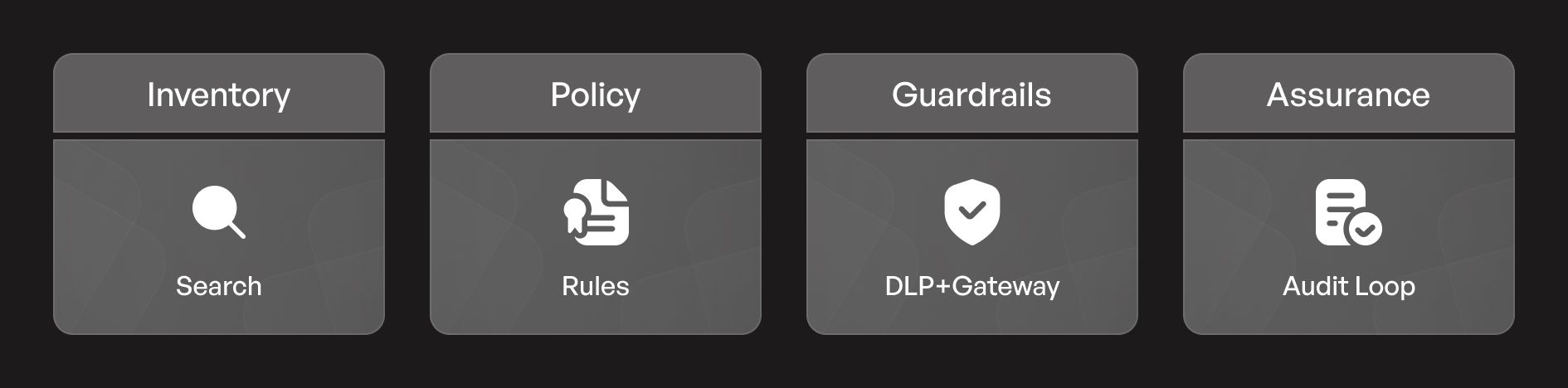
1. Inventory Before Innovation
You cannot govern what you cannot see.
- Discover AI Usage: Utilize AI-powered Security Service Edge (SSE) platforms, combining Cloud Access Security Broker (CASB), endpoint DLP, and proxy capabilities, to maintain full visibility into GenAI traffic across both on-premises and remote environments.
- Map Data Flows: Understand which repositories (CRM, ERP, source code, file shares) are feeding prompts directly or via connectors.
- Catalog Tools: Establish a living register of approved AI services and explicitly track unsanctioned tools with associated risk levels.
2. Policy and Risk-Based Access
Once an inventory exists, governance can move from generic warnings to concrete rules.
- Define AI Usage Policy: Codify what data classes (for example, payment data, health data) may never be sent to external GenAI, and under what conditions internal AI platforms may consume sensitive data.
- Risk-based Access Tiers: Establish rules for tools. For example, Tier 1 high-risk tools are blocked; Tier 2 moderate-risk tools allow read-only, anonymized, or synthetic data, and full usage is reserved for managed devices and within specific roles.
- Align with Regulations: Ensure policy explicitly references applicable frameworks and laws (NIST AI RMF, sectoral regulations, EU AI Act, etc.).
3. Guardrails in the Data Path
Operationalize policy via guardrails where data flows.
- AI-aware DLP and CASB: Extend DLP policies to GenAI endpoints, inspecting prompts and file uploads in real time to block or redact sensitive data before it leaves the organization. Industry data shows that only around half of organizations have this in place today, despite rapidly increasing policy violations.
- Secure AI Gateways and Proxies: Route GenAI calls, both user and application integration traffic, through gateways that handle authentication, encryption, and logging. For example, in our architecture, integrating identity providers with SSE gateways ensures only authenticated users on compliant devices reach sanctioned GenAI tools.
- Pattern Libraries for Safe Prompts: Offer approved prompt templates, context windows, and integration patterns (for example, a retrieval-augmented pattern that keeps sensitive data in a private vector store).
4. Continuous Assurance and Monitoring
GenAI systems evolve too quickly for a one-time risk assessment. Establish a cross-functional GenAI council to track metrics like blocked uploads and newly discovered apps. Apply risk assessment gates at each stage of the GenAI solution lifecycle, from pilot to production.
Aligning AI Accountability: Three Lines of Defense
Governance-first security is as much about operating model as it is about technology. A practical structure often mirrors the “three lines of defense” concept adapted for AI:
| Line of Defense | Owner | Key Responsibilities |
| First Line | Business & Product Teams | Identify use cases, classify data sent to AI systems, and apply approved templates for safe usage. |
| Second Line | Central AI Governance & Security | Define policy/risk appetite, approve or deny GenAI tools, and operate AI gateways, DLP, and CASB controls. |
| Third Line | Audit & Assurance | Periodically review control effectiveness, policy adherence, and validate that reported usage aligns with reality. |
Clear Responsible, Accountable, Consulted, and Informed (RACI) Matrix definitions around GenAI use cases, from idea intake to decommissioning, are critical. Without this, shadow AI fills the vacuum as teams move faster than central functions can respond.
A 90-Day Blueprint for Secure AI Adoption
Enterprises often ask a simple question: Where do we start? Based on our own phased rollout and internal learnings, the following is a pragmatic 90-day plan to establish a minimum viable governance-first model.
Days 1-30: Discovery
- Run discovery for GenAI traffic across proxies, firewalls, and CASB tools.
- Identify top GenAI applications in use (sanctioned and unsanctioned).
- Map which business units and roles are driving the highest usage.
- Draft an interim AI usage guideline to reduce risky behaviors while governance is being formalized.
Days 31-60: Codify Policy and Implement Controls
- Formally sanction a dedicated GenAI governance working group.
- Define prohibited and restricted data categories for GenAI usage.
- Implement or extend DLP and CASB policies specifically for GenAI endpoints.
- Deploy an AI gateway or secure proxy for at least one sanctioned GenAI platform and route pilot traffic through it.
Days 61-90: Operationalize and Scale
- Document approved GenAI usage patterns and publish them as reference architectures.
- Extend AI-aware DLP to additional high-risk channels (developer tools, collaboration platforms).
- Integrate GenAI risk checks into existing change management and solution review processes.
- Establish monthly metric reporting to the governance forum and quarterly summaries to executive leadership.
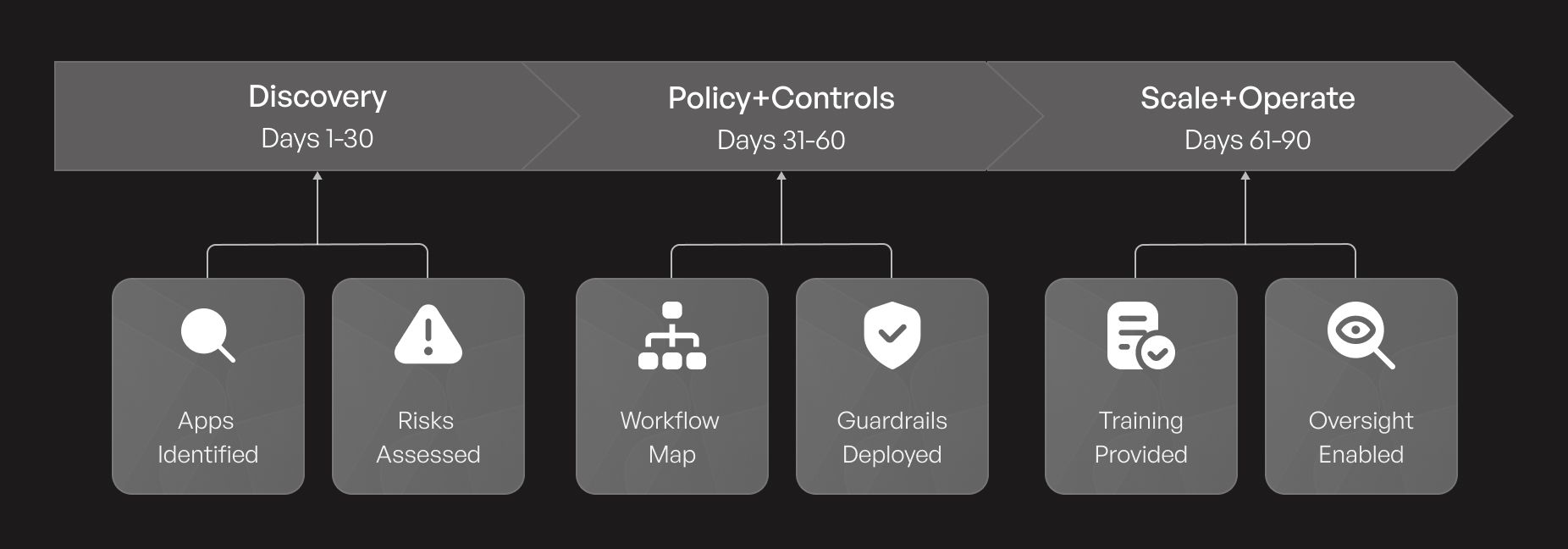
This is not the final state, but it is sufficient to move to a controlled, observable environment where innovation and security can coexist.
Characteristics of a Mature GenAI Governance Program
A governance-first GenAI security model should be judged less by the number of blocked prompts and more by its ability to support safe, scalable adoption. Success indicators include:
- Reduced Surprise: Shadow AI tools and traffic become rare; new tools are surfaced via discovery and quickly triaged through governance.
- Fewer Risky Prompts: Policy violations tied to GenAI start to plateau and then decline as guardrails and training work together.
- Improved Breach Economics: Fewer incidents involve GenAI; when they do, logs, policies, and architectures allow faster containment.
- Regulatory Readiness: The organization can easily prove to auditors that its GenAI usage aligns with global AI risk management frameworks (such as the NIST AI RMF or ISO/IEC 42001) and emerging regulations (like the EU AI Act).
- Business Momentum: More business units confidently bring GenAI use cases to production through standardized, approved paths rather than going rogue.
Ultimately, the aim is not to eliminate shadow AI by decree, but to make the sanctioned path to GenAI clearly safer, easier, and more valuable than the alternatives.
Closing Thoughts
Shadow AI is the predictable byproduct of powerful tools meeting unmet needs. The response cannot simply be more blocking or another point solution. Enterprises that succeed with GenAI will treat it as a first-class citizen in their governance and security architecture: visible, policy-driven, and controlled at the points where data moves.
By starting with inventory, codifying risk-based policies, inserting guardrails across the data path, tracking the provenance of AI-generated assets, and anchoring everything in a clear operating model, organizations can turn GenAI from a leakage multiplier into a governed capability.