


As agentic AI takes on more decision-making and execution within enterprise applications, Quality Engineering (QE) teams face a different testing problem. Unlike traditional software, these systems are non-deterministic: the same request may follow different execution paths or generate different responses while still reaching a valid outcome. A generated response may appear correct even when the underlying agent selects the wrong API, omits critical parameters, or hallucinates information. Relying solely on the final output can create a false sense of confidence in system quality.
Reliable testing of agentic systems requires QE teams to evaluate more than the final response. They need to understand how the agent reached that response, whether it made the right operational decisions, and whether those decisions were appropriate for the task.
Our AI Quality Engineering Framework addresses this challenge by making intermediate agent behavior observable, measurable, and testable throughout the development lifecycle.
What’s in this article:
- Why does agentic AI require a different approach to quality engineering?
- How can QE teams test the behavior of AI agents?
- How our AI Quality Engineering Framework evaluates execution, agent decisions, and response quality
- How structured evaluation helps detect regressions and support release decisions as models, prompts, and tools change
Agentic AI Requires a Different QE Approach
Traditional software testing typically validates whether a predefined input produces an expected outcome. With agentic AI, QE must extend that validation to the decisions and actions that lead to the outcome.
This was a key consideration in our approach to testing an enterprise-grade agentic AI application for a leasing platform. The application coordinated multiple AI agents and invoked backend tools to retrieve property data dynamically. In addition to validating the application’s functional behavior, we designed our QE approach to evaluate how the agents handled each interaction.
This meant testing questions that conventional functional checks do not typically address:
- Was the request routed to the correct specialized agent?
- Were the appropriate backend tools selected?
- Were tool parameters interpreted accurately?
- Was the final response grounded in retrieved data, or did the model hallucinate a plausible-sounding answer?
From Observability to Behavior Evaluation
Modern observability platforms such as LangSmith provide valuable visibility into execution traces, agent interactions, and tool calls. But observability alone is not enough. A trace can confirm that a tool was invoked; it cannot determine whether that tool was appropriate for the user’s intent or whether the resulting decision was correct.
We, therefore, built our AI Quality Engineering Framework around a simple principle: AI behavior must be observable before it can be evaluated, and it must be evaluated before it can be trusted.
AI behavior must be observable before it can be evaluated, and it must be evaluated before it can be trusted.
The Three-Layer AI Evaluation Framework
To move from simply observing AI behavior to actually validating it, we implemented a three-layer evaluation flow in our QE framework. Every user interaction is assessed at the execution, decision, and response-quality levels before it is considered release-ready.
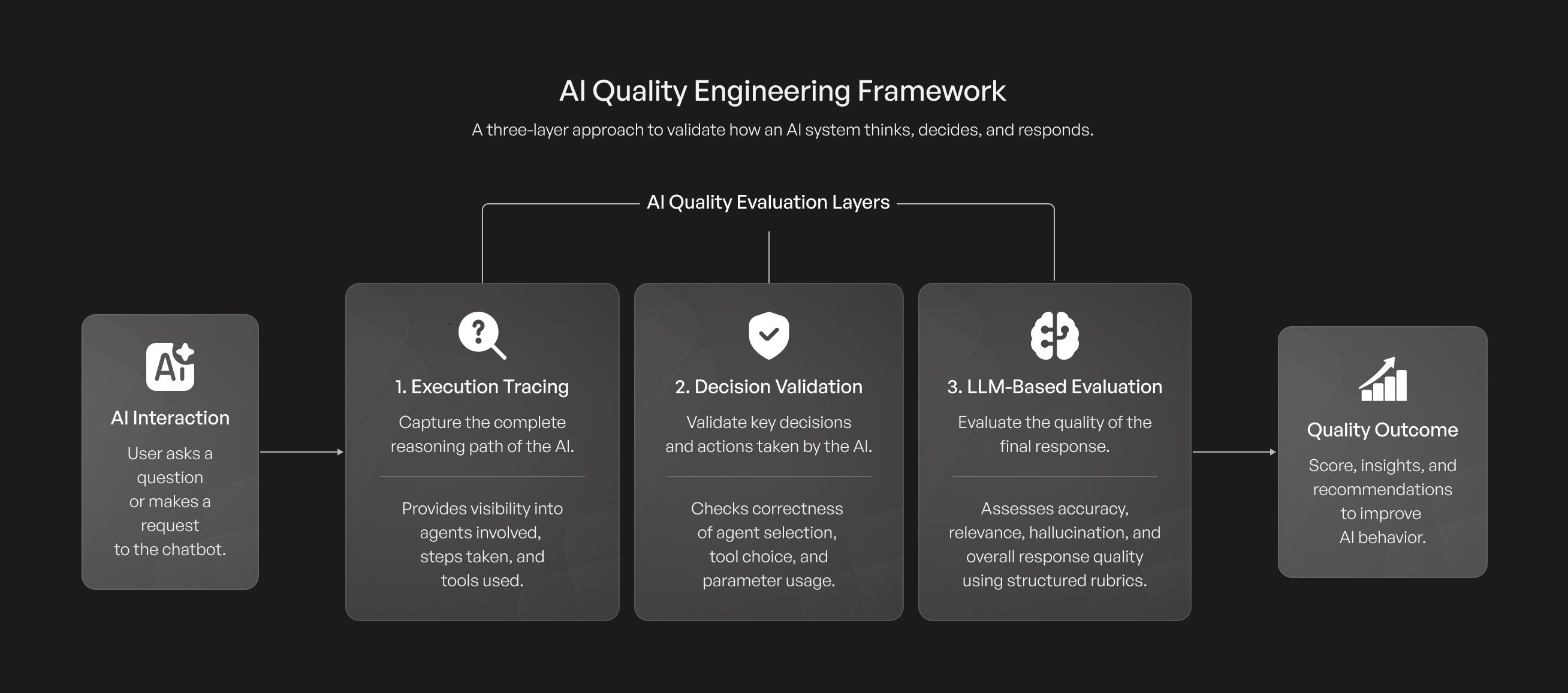
1. Execution Tracing
We implemented execution tracing through LangSmith instrumentation in our QE framework, so every conversation turn is captured as a structured runtime trace.
For each user request, the framework records agent routing, tool calls, tool arguments, tool outputs, intermediate reasoning checkpoints, and final response metadata in sequence.
Inside the framework, this works as a trace-first pipeline: test execution emits interaction events, the events are normalized into a single schema, and the run is persisted as a chronological conversation trace in LangSmith. Because traces are standardized across runs, QE can reliably replay paths, compare behaviors build-to-build, and identify exactly where the agent workflow diverged.
While this layer establishes what happened during an interaction, the next layer determines whether those actions were correct.
2. Decision Validation
A decision-validation layer on top of trace capture checks whether the system made the right operational choices for user intent.
We configured the framework with two types of checks:
- Standard quality evaluators to monitor hallucination, toxicity, bias, and fairness checks
- Custom task evaluators tailored to business workflows
For the leasing agent, we introduced a custom tool-correctness evaluator to verify that the selected backend tool, input parameters, and invocation order were appropriate for property-related questions.
We added this because many failures were not hard crashes; they were decision-quality errors: the system responded fluently but used the wrong tool path or incomplete parameters, which risks inaccurate leasing information.
Once we could validate the agent’s decisions, we also needed to assess the quality of the response those decisions produced.
3. LLM-as-a-Judge
For response-quality assessment, we operationalized an LLM-as-a-Judge pipeline in the framework.
The framework assembles inputs from three sources:
- Conversation context from trace history
- Evidence from tool outputs
- The agent’s final generated response
The judge model scores every turn against a fixed evaluation rubric covering factual accuracy, contextual relevance, data grounding, hallucination risk, and overall usefulness, allowing quality to be tracked reliably across runs and releases.
The framework aggregates these results at turn-level and conversation-level to produce comparable quality metrics over time. This makes conversational quality regression-testable: model, prompt, or toolchain changes can be measured for quality drift before release.
The QE Impact: From Testing to Engineering Trust
The three layers work together to give QE a more complete view of an agent interaction.
For leasing conversations involving pricing, availability, and property details, failures could now be isolated to the exact layer:
- Incorrect agent routing
- Wrong tool choice
- Incomplete or incorrect tool parameters
- A mismatch between retrieved data and the generated response
- Low-quality final responses despite technically successful execution
Essentially, our QE approach shifted from:
- Pass/fail conversation checks to decision-level validation
- Manual transcript inspection to repeatable evaluator-driven scoring
- “Response looks reasonable” to evidence-backed grounding and correctness checks
- Post-release discovery of subtle AI drift to pre-release detection in regression cycles
Making AI Quality Actionable Across Teams
The framework also made AI quality signals useful to different stakeholders:
- Quality engineers gain deterministic diagnostics and reproducible failure evidence from traces.
- Application engineers can identify where an agent workflow failed and which decision needs attention.
- Product leaders gain measurable quality signals that can inform release decisions.
- Clients are confident that leasing responses are correct and grounded, not just fluent.
This is particularly important for enterprise AI systems where a plausible response is not sufficient evidence of correctness. Teams need a way to understand and measure the behavior behind that response.
Governing AI Quality in Production
Agentic AI has expanded what QE needs to validate. Functional testing remains essential, but it is only one part of assuring an AI system that can make decisions, invoke tools, and dynamically determine how to complete a task.
Our AI Quality Engineering Framework addresses this by treating agent behavior as a testable engineering concern. It captures execution traces, evaluates operational decisions, and measures response quality against defined criteria.
This makes AI quality more measurable across development and release cycles. Model changes, prompt changes, and toolchain changes can be evaluated against the same behavioral signals. Regressions can be identified earlier, and release decisions can be supported by evidence.
For agentic systems, that is the shift QE needs to make: from asking whether the system produced an acceptable answer to evaluating whether the system behaved appropriately to produce it.
Explore our Quality Engineering Services to learn how we can help you build more reliable agentic applications.