


Enterprise data platforms evolve over years, often leaving business rules and data dependencies buried in legacy code and analytics workflows. Some of this logic may be poorly documented or known only to the teams that built it. Recovering that missing context is a key challenge in automating migration.
We built QShift to address this challenge. QShift combines structured metadata analysis, AI-assisted reasoning, and deterministic automation to help organizations assess migration complexity, identify risks and information gaps, and migrate supported BI and ETL assets in a more controlled and predictable manner.
What's in this article:
- How QShift combines discovery and automation through a structured, repeatable migration framework.
- The six phases of the QShift migration workflow, from metadata ingestion to verification.
- How GenAI and human expertise unite to resolve dark metadata and implicit business logic.
- How automated validation checks data integrity, business logic, platform structures, and security controls.
A Structured Approach to Data & Analytics Migration
Traditional data migrations rely heavily on custom conversion scripts and platform-specific tools. Missing metadata and differences in how source and target platforms represent business logic can leave rule-based conversion scripts unable to complete a conversion or introduce errors in production that go unnoticed until later. This breakdown occurs because point-to-point tools attempt direct code translation without grasping the underlying system context, turning each migration into a disjointed, high-friction engineering task. To resolve this friction, QShift provides a structured, repeatable migration framework. By decoupling source extraction from target generation, QShift provides two complementary capabilities:
- Automated Migration Assessment: Analyzes available metadata and code structures to establish a clear view of migration readiness and identify assets that require domain review.
- Intelligent Migration Automation: Converts workloads deterministically when logic is clear, while routing ambiguous code or incomplete metadata to experts for review.
Together, they transform unpredictable lift-and-shift projects into a controlled engineering process.
How Does QShift Handle Each Stage of Migration?
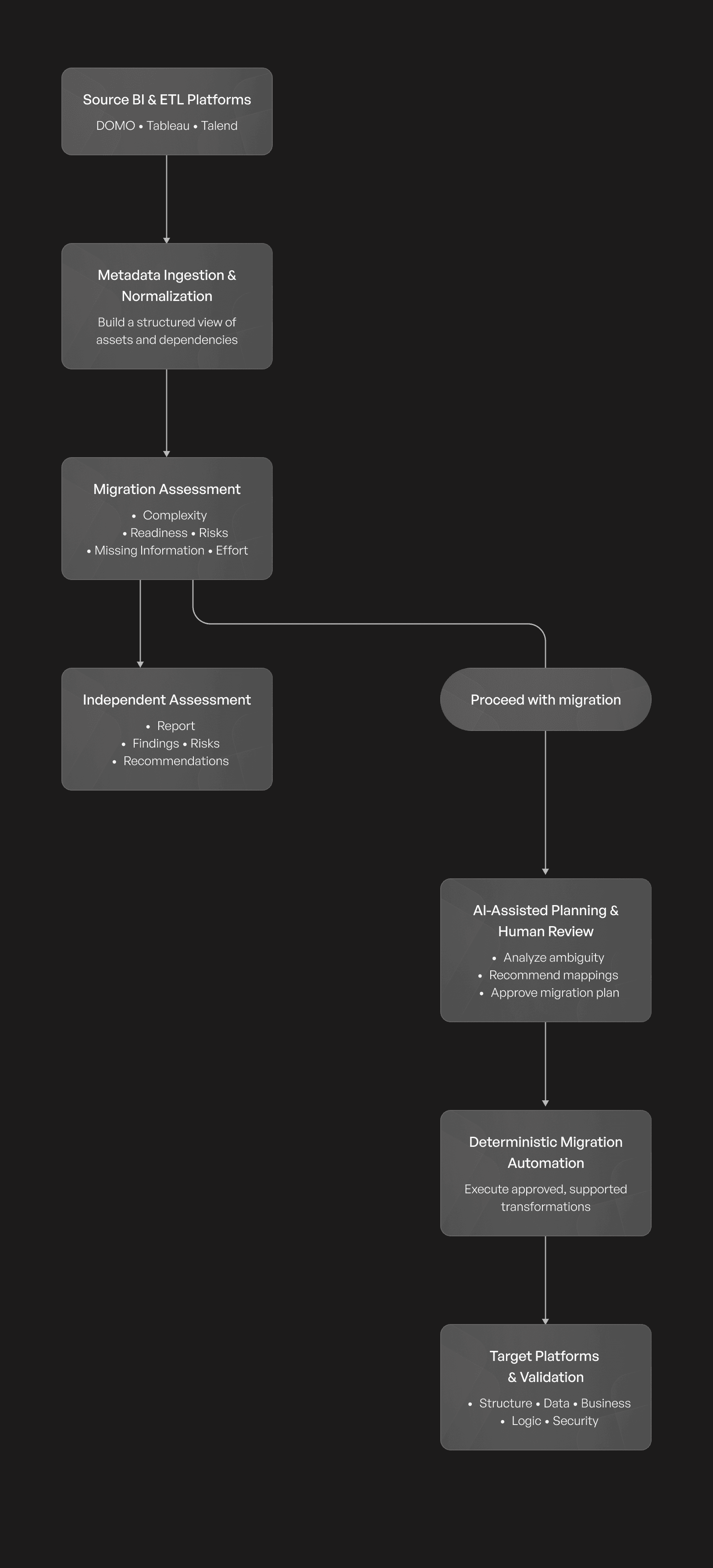
QShift separates platform-specific integrations from core migration intelligence across six operational phases:
1. Metadata Ingestion & Normalization
Source connectors query supported platform APIs and repositories to construct a vendor-neutral representation of available datasets, transformation dependencies, visual structures, and permissions. Since source platforms represent similar concepts in different ways, normalization brings the available metadata into a consistent structure. This allows QShift's downstream components to analyze assets and their relationships without relying on source-specific terminology. Understanding these dependencies also helps identify which assets may be affected by a change and informs the planning of migration activities.
2. Independent Assessment
QShift assesses the available metadata to identify asset dependencies, missing information, factors that may increase migration complexity, and potential risks. This helps teams understand migration readiness and identify assets that need further investigation before work begins.
When the available metadata is incomplete, QShift generates targeted questions to gather additional context from users. It combines their responses with the metadata to develop a more informed assessment of complexity, overall readiness, expected effort, and migration risks. This gives stakeholders a clearer basis for prioritizing workloads and deciding where manual architectural refactoring is required.
3. AI-Assisted Reasoning & Planning
Generative AI models analyze unmapped attributes, calculations, configurations, and available code context to recommend potential mappings to target-platform concepts. When metadata is incomplete or the intended business meaning is unclear, QShift flags the case for domain-expert review.
4. Human-in-the-Loop Review
Technical metadata does not always capture the intended business meaning of an asset. When AI recommendations require clarification, QShift brings domain experts into the review process to validate or correct those recommendations and provide additional context.
For example, QShift might recommend a category axis based on the field types in an underlying dataset. An engineer can review the suggestion and confirm whether it reflects the intended visualization. Similarly, complex calculations, custom business rules, and security policies may require domain expertise before the migration plan is approved.
This approach combines AI-assisted analysis with human judgment, helping resolve ambiguities while keeping migration decisions under expert oversight. The goal is not to automate every decision but to use AI where it adds value and involves people when business context is needed.
5. Deterministic Execution
Approved blueprints flow directly to execution modules, which synthesize native target artifacts. Depending on the migration, these may include Microsoft Fabric Dataflows, Power BI semantic models, or Azure Data Factory pipelines.
The approved migration plan provides the instructions for executing supported transformations and creating the corresponding target artifacts. Target-specific integrations manage platform differences, while the workflow monitors progress and identifies failed or blocked operations. If a source asset has no direct equivalent, teams may need to apply custom transformations or reconstruct it manually. This approach keeps execution controlled and repeatable without assuming that every asset can be converted automatically.
6. Multi-Pillar Verification
Creating an object in the destination platform does not necessarily mean that the migration was successful. A report may be recreated cleanly but produce different results. A dataset may load successfully but contain discrepancies. A business calculation or security policy may behave differently from its source equivalent.
QShift validates migrated assets across four pillars: structure, data, business logic, and security. These checks help teams identify differences between the source and target environments and determine what needs further investigation.
| Validation Pillar | Focus Area | Verification Strategy |
| Structure | Schema & Topology | Verifies that visual properties, column data types, table relationships, and pipeline parameters are accurately reconstructed. |
| Data | Precision & Completeness | Compares row counts, null distributions, column checksums, and aggregate field values between source and target storage layers. |
| Business Logic | Expression Integrity | Tests mathematical formulas, conditional statements, and edge cases to ensure DAX, PySpark, or SQL expressions produce identical outputs. |
| Security | Access Control | Confirms that Role-Based Access Control (RBAC) and Row-Level Security (RLS) policies translate accurately without expanding access boundaries. |
Validation results give teams clear visibility into verified assets, existing differences, and items requiring human review. Teams can use this information to make better-informed decisions about migration readiness and cutover.
Conclusion
QShift provides a controlled, systematic approach to data and analytics migration by combining structured metadata analysis, GenAI-assisted reasoning, deterministic execution, and human-in-the-loop governance. By making gaps and uncertainties visible and checking converted assets against their source, engineering teams gain a clearer basis for planning and managing data and analytics modernization.
Discover QShift’s core modernization use cases to see how we automate complex BI, ETL, and data warehouse conversions, or speak with our data experts to evaluate your current stack.