
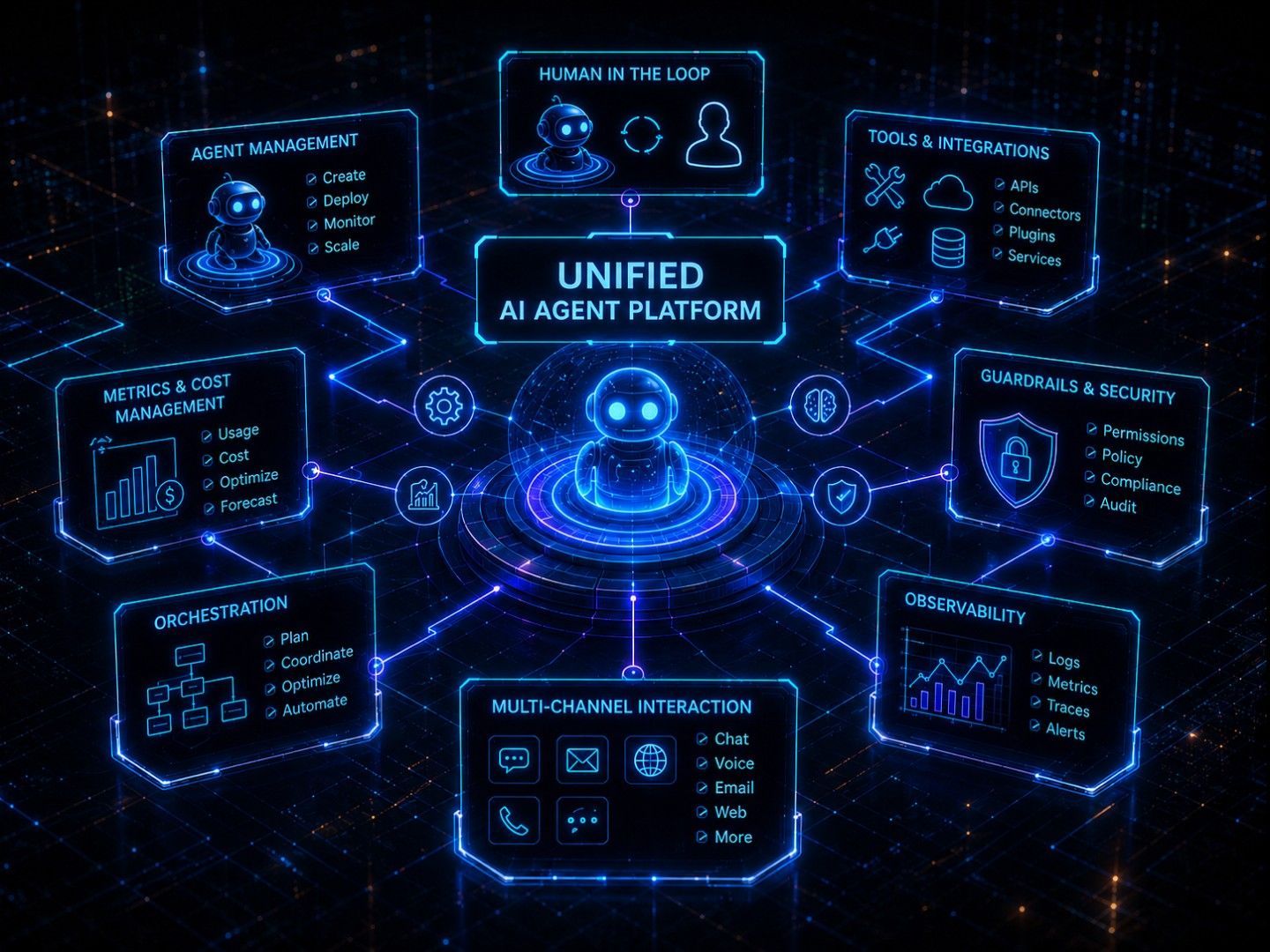

While enterprises have started actively deploying autonomous agents, they are also running into a new problem: agent sprawl.
Agent sprawl occurs when isolated AI agents are deployed across fragmented silos—like AWS, Azure, Dify, and custom stacks—resulting in an unmanaged ecosystem that undermines efficiency, creates massive security blind spots, and increases technical debt.
To solve this, organizations need a centralized orchestration layer. QBurst’s Managed Agents™ Platform provides this exact control plane, unifying disparate AI agents under a single operational and governance framework.
What’s in this article:
- Why managing agents across different providers is problematic
- How QBurst’s Managed Agents Platform standardizes agent management
- How observability, human oversight (HITL), and tenant isolation work under the hood
- How risk is mitigated across Insurance, Manufacturing, and Global Enterprises
- How QBurst’s recognition as a Horizon 1 Disruptor validates our engineering-led approach
Why Multi-Cloud AI Agents Are Difficult to Manage
Managing AI agents across heterogeneous ecosystems introduces several points of failure that stall enterprise adoption.
Fragmented Management
Each provider offers different APIs, invocation models, and billing systems, forcing teams to manage agents in isolation. It is like running five separate CRMs across five business units with no shared customer record; there is no means of viewing the entire agentic landscape.
Limited Observability
Execution data, such as model interactions, tool calls, and decision paths, is spread across provider-specific dashboards. This makes troubleshooting difficult and reduces traceability, particularly in regulated environments.
Governance without Guardrails
Policies and guardrails are often implemented at the provider level. A control enforced in one environment may not exist in another, creating gaps in oversight and risk management.
Cost Opacity
With usage metrics distributed across different dashboards, finance teams cannot accurately answer what their AI actually costs last quarter. Not being able to attribute costs per tenant or business unit hampers ROI analysis.
Together, these challenges make enterprise-scale agent operations difficult to govern. As AI initiatives expand beyond isolated pilots, organizations need an operating layer that sits above individual platforms and provides centralized control.
Managed Agents Platform: A Unified Control Plane for AI Agents
Most organizations do not intentionally adopt a multi-cloud AI strategy. It typically evolves as different teams choose the tools that best fit their needs: AWS Bedrock for one use case, Azure AI Foundry for another, Dify for rapid experimentation, and custom LangChain implementations for specialized workflows.
QBurst's Managed Agents Platform addresses the challenge of fragmented operations through a centralized orchestration layer that operates across cloud providers and agent frameworks. It standardizes every interaction so that teams need to interact only with a single system, regardless of the underlying provider.
Standardized Agent Management
Managing agents across multiple platforms often requires separate integrations and operational processes for each provider. The platform abstracts these differences through a common interface for agent discovery, invocation, and lifecycle management.
By handling provider-specific complexity behind the scenes, it simplifies administration and allows teams to focus on business outcomes rather than platform-specific implementation details.
Deep Observability & Traceability
Agent workflows are rarely simple. A single request may involve multiple model interactions, tool calls, validations, and external system integrations before a final result is produced.
The platform consolidates execution telemetry into a single view, enabling teams to understand how agents operate and where issues occur. Key capabilities include:
- End-to-end execution traces showing how decisions are reached.
- Visibility into interactions with external systems such as databases, CRMs, ticketing platforms, and internal applications.
- Detailed usage metrics and token consumption data across agents, tenants, and business units.
This level of transparency supports troubleshooting, compliance reporting, and operational monitoring.
Human-in-the-Loop (HITL) Workflows
Not every decision should be fully autonomous. Workflows involving financial approvals, customer-facing communications, or compliance-sensitive actions often require human review.
The platform supports human-in-the-loop (HITL) workflows by introducing configurable approval checkpoints within agent processes. Reviewers can approve, reject, or modify actions before execution continues, ensuring appropriate oversight without disrupting automation.
Multi-Tenant Governance and Cost Tracking
The platform enables tenant-level controls and policy enforcement while supporting independent operations across business units, regions, and departments. It also provides detailed cost attribution by provider, agent, workflow, and tenant, giving leaders a clearer understanding of AI usage and spend.
Managed Agents Platform Architecture
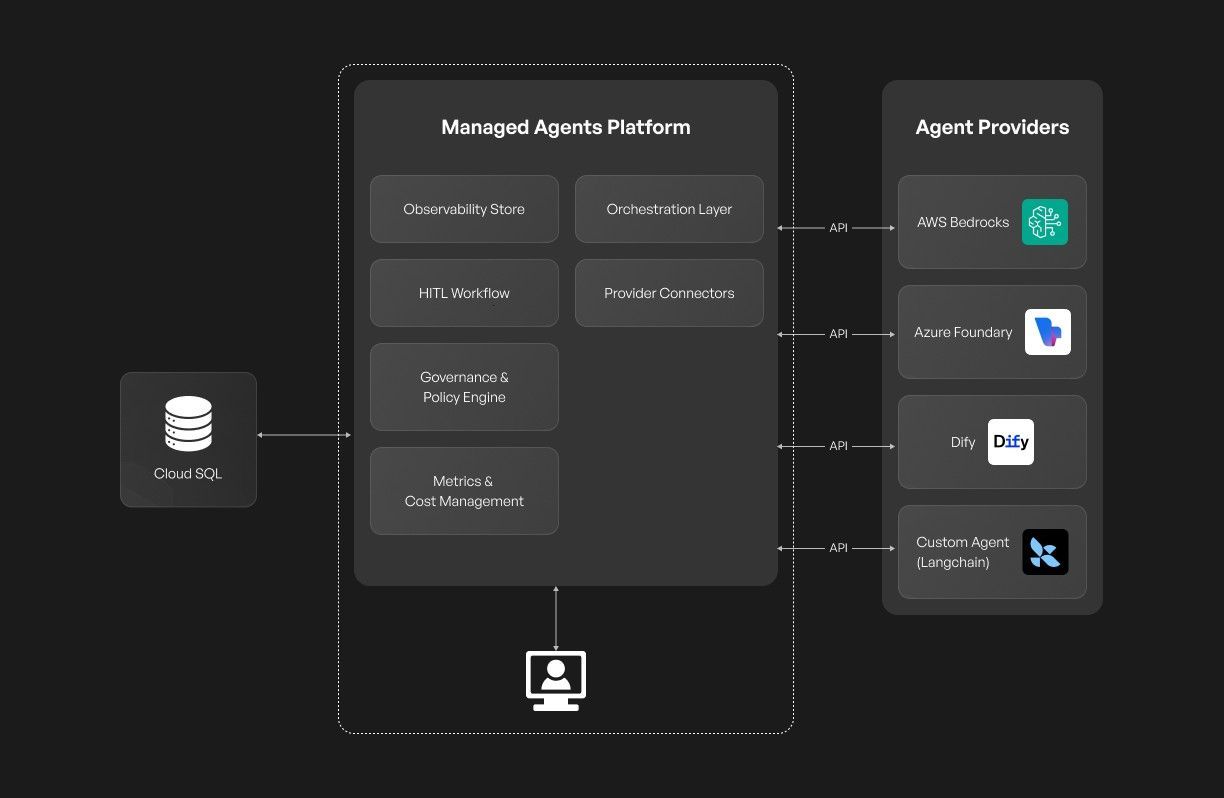
The platform features a cloud-agnostic design that integrates with and governs the existing infrastructure:
- Orchestration Layer: Coordinates workflows, scheduling, provider integrations, and agent lifecycle management.
- Provider Connectors: Unified API bridges that normalize communication with AWS Bedrock, Azure AI Foundry, Dify, and custom LangChain agents.
- Governance & Policy Engine: A centralized policy controller that coordinates and applies both provider-native and custom, platform-defined guardrails.
- Observability Store: Captures execution traces, usage metrics, and operational telemetry for analysis and auditing.
- HITL Workflow Engine: Orchestrates manual interventions.
AI Agent Governance for Insurance, Manufacturing, and Global Enterprises
This Managed Agents platform is critical in environments where unmonitored or misaligned AI actions can carry severe compliance or financial consequences.
Insurance & Financial Services
Regulatory frameworks such as IFRS 17 and HIPAA increase the need for traceability, auditability, and documented decision processes. Ungoverned agents running across cloud providers cannot produce this. The platform’s Observability Store and HITL workflows ensure every agent action is logged, traceable, and human-reviewable before sensitive outputs are finalized.
Manufacturing
Multi-agent supply chain coordination spans multiple plants, suppliers, and systems, often across different cloud environments. Without a unified control plane, there’s no way to enforce consistent guardrails or attribute costs per operation. The platform’s tenant isolation and standardized API layer make cross-environment orchestration manageable at scale.
Global Enterprises
Organizations with multiple business units need cost attribution and governance that travels with the agent, not the cloud provider. The platform’s multi-tenant architecture enforces unit-level policies and tracks spend per invocation, per provider, and per tenant, turning AI cost management into a real-time operational metric.
Building for the Agentic Future
It is perilous to run operations without a governed control tower as AI agents grow more autonomous. AI experiments fail at the enterprise level, not because the agents aren’t capable, but because the infrastructure governing them isn’t. Visibility gaps, inconsistent guardrails, and cost opacity compound quickly at scale. A unified orchestration layer addresses all three simultaneously, turning siloed agents into a cohesive, auditable, and high-performance digital workforce.
This is the direction enterprise AI is moving, and it’s where QBurst has focused its engineering. The HFS Horizons: Data Modernization and AI, 2026 report reflects this deliberate focus. Our Managed Agents framework is a direct expression of our engineering-led approach, purpose-built to provide the multi-agent orchestration and cross-cloud interoperability that enterprise ecosystems currently lack.
If you are navigating multi-cloud agent complexity or evaluating how to bring consistency and control to your AI operations, we’d like to show you what governed intelligence looks like in practice.