
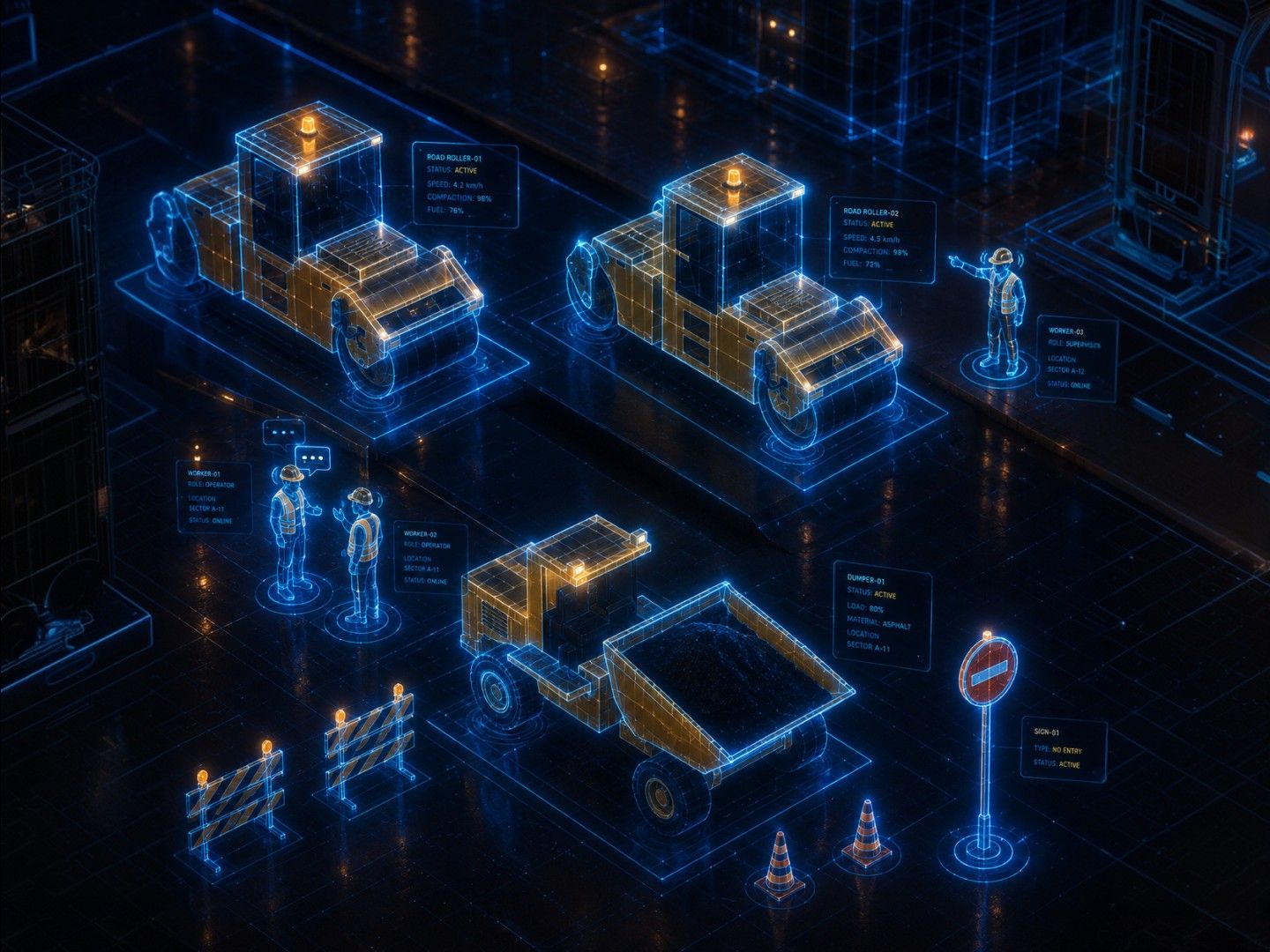

In worksite safety, the speed of response is everything. But what happens when the very system designed to keep workers safe starts burying critical alerts under hundreds of routine ones?
That was the reality for the users of our client’s worksite vehicle safety platform, a system that monitors vehicle intrusion across industrial worksites using a network of sensors. The system does its job well: it detects potential threats and fires alerts. The problem was volume. Hundreds of alerts per day, per site, each requiring human eyes to review, classify, and act on. And buried somewhere in that flood of notifications were the ones that truly mattered.
We set out to fix that.
What's in this article:
- Why manual alert review wasn’t helping worksite safety operations
- How we designed a two-layer AI pipeline to automate triage
- When the system auto-rates an alert vs. routes it to a human reviewer
- The severity matrix that drives consistent, rule-based decisions
When Safety Alerts Become a Bottleneck
Every alert in the system is rated on a 1-5 severity scale:
- Rating 1 is a false alarm.
- Rating 2-3 represents varying degrees of vehicle intrusion risk.
- Ratings 4-5 are critical incidents: near-misses, accidents, or situations requiring immediate human escalation.
In theory, safety officers should focus almost entirely on ratings 4 and 5. In practice, they were wading through hundreds of 1s, 2s, and 3s just to find them.
The numbers told the story clearly:
| Problem | Metric | Impact |
| Review Volume | Hundreds of alerts generated daily, per site | Safety teams are in constant reactive mode |
| Time Per Alert | Up to 5 minutes for review, analysis, and classification | Can exceed 10 hours of manual review per week per large site |
| Inconsistency | Subjective human judgment on routine ratings (1–3) | Variable safety reporting; hard to benchmark across sites |
| Delayed Response | Critical alerts are buried in the queue | Slower reaction time to events that actually require intervention |
The situation demanded more than a workflow improvement. We needed intelligent triage or a system that could reliably handle the routine, so humans could manage the critical.
Our Solution: A Two-Layer AI Pipeline
We designed our solution, Alert Rating AI, as a sequential, two-layer pipeline. Each layer has a distinct role, and together they automate up to 90–95% of routine alert classification while keeping human judgment firmly in the loop for anything serious.
The core design principle was deliberate: the AI should never assign a Rating 4 or 5. Those belong exclusively to human reviewers. Our job was to reliably clear everything below that threshold.
Layer 1: False Alarm Detection
The first layer is a computer vision pipeline that analyzes video footage attached to each alert. Its goal is to answer one question: Is there actually a vehicle approaching the sensor? We track how bounding boxes move across frames. If all vehicles are moving away from the sensor, staying stationary, or exhibiting any non-approach behavior, then it is flagged as a false alarm (Rating 1) and exits the pipeline.
Only alerts where any of the vehicle is consistently approaching the sensor make it through to Layer 2.
We built this using:
- RF-DETR: a transformer-based real-time object detection model that identifies vehicles in each video frame.
- ByteTrack: a multi-object tracking algorithm that maintains consistent vehicle identity across frames, enabling full trajectory analysis.
- OpenCV: for video preprocessing, frame extraction, and enhancement before analysis.
Layer 2: Severity Assessment
For alerts that pass Layer 1 (or where no video is available), Layer 2 takes over. Here, we shift from computer vision to a rule-based inference engine that works on structured sensor telemetry.
Each alert carries a JSON payload with the following key data points:
- track_speed: vehicle velocity in m/s
- track_range: distance from the sensor in meters
- track_rtc_time: timestamp, used to calculate available reaction time
These are converted to appropriate units (mph, feet) and fed into a Severity Matrix to assign a Rating 2 or 3.
The Severity Matrix: Where the Decisions Get Made
The matrix is the heart of Layer 2. It encodes the same reasoning that experienced safety officers apply when reviewing a genuine vehicle intrusion event, but applied uniformly, instantly, and at scale.
| Condition | Speed | Distance | Reaction Time | Rating | Classification |
| Critical Near | ≥25 mph | ≤100 ft | <2.5s | 3 | Near Miss |
| Critical Proximity | Any | <2 ft | Any | 3 | Near Miss |
| Critical Time | Any | Any | <2.5s | 3 | Near Miss |
| Moderate Alarm | ≥15 mph | ≤200 ft | ≥2.5s | 2 | Alarm |
| Low Alarm | <15 mph | >200 ft | ≥2.5s | 1 | False Alarm |
Three independent conditions can trigger a Rating 3: critical speed and proximity, dangerously close range, or critically short reaction time. Any one of them is sufficient. This design means we are on the side of caution: if any dimension of a scenario looks critical, it gets treated as critical.
The AI system is hard-coded to never assign them Ratings 4 and 5. When a Rating 3 incident requires further review (because video evidence suggests an actual collision, injury, or extreme near-miss) a human reviewer makes that call. That boundary is non-negotiable in our design.
Keeping Humans in the Loop by Design
The pipeline is structured so that every alert still surfaces to a human interface. For auto-rated alerts (Ratings 1–3), the UI functions as an audit log; reviewers can check, override, and provide feedback. For anything the system is uncertain about, or any alert that could potentially be a 4 or 5, is flagged for mandatory human review.
This creates a system where human expertise is amplified, not replaced. Instead of spending 10 hours a week reviewing routine false alarms, safety officers spend their time on the events that actually need them.
We also built in transparency at every step. Each alert carries an AI label alongside its automated rating, making it clear which ratings were AI-assigned and which were human-confirmed. Override actions are logged, creating an audit trail that supports both accountability and continuous improvement.
The Outcome
We validated the system against a blind test set of 1,000 historical alerts that had been previously rated by human operators across multiple worksites. The results showed that the model could handle routine alerts with a high level of accuracy while reducing the amount of manual review needed.
- 90% match with human ratings for non-critical incidents (Ratings 1–3).
- Up to 90–95% of routine alerts can be processed automatically without human review.
- 100% of human reviewer time can be directed at Rating 4–5 events, the ones that matter most.
- Estimated 70% reduction in total manual review time per site.
The consistency improvement was equally significant. Because the system applies the same rules every time, ratings no longer vary based on who happens to be reviewing the queue on a given day. That uniformity matters enormously for safety benchmarking and cross-site performance comparisons.